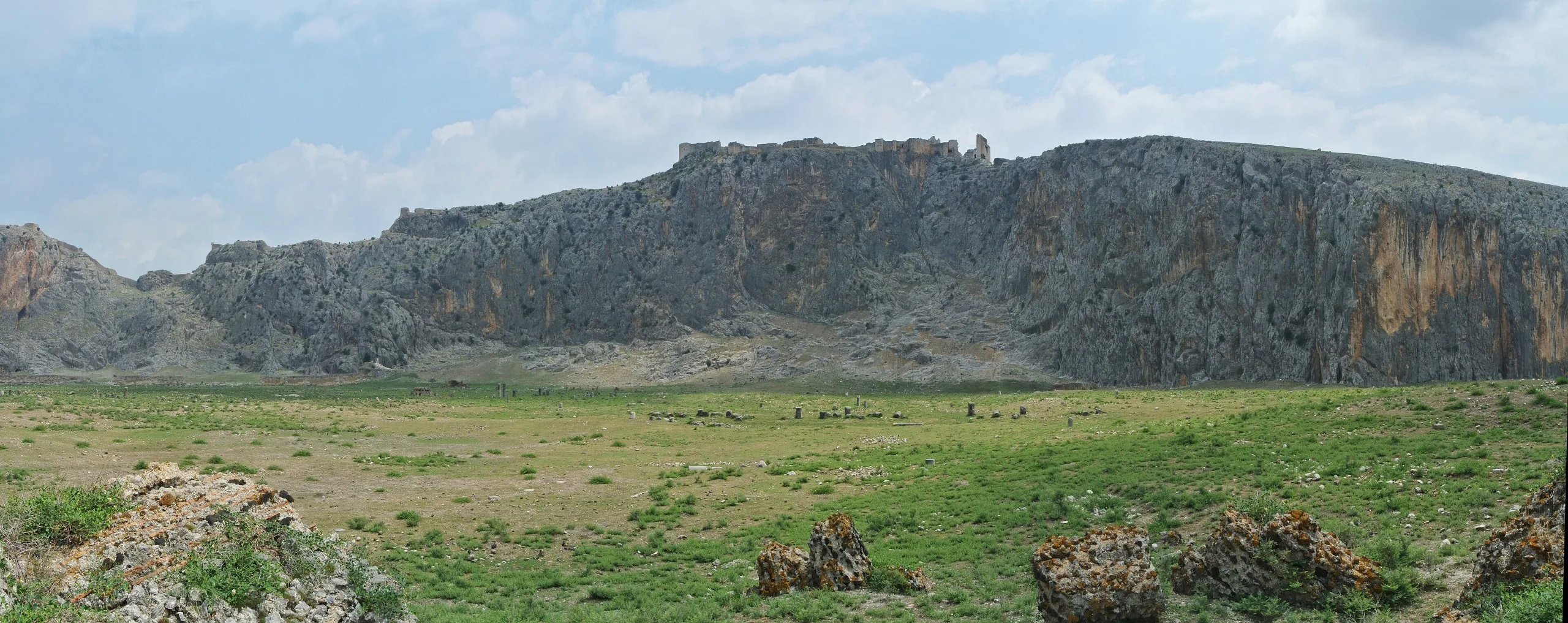
The Germanicia mosaic site in Dulkadiroğlu, Kahramanmaraş, holds late Roman and early Byzantine villa mosaics from the ancient city of Germanicia.
Germanicia Mosaic Site is an ancient city located in Turkey, Kahramanmaras. Main periods: Roman Period, Byzantine Period.
The Germanicia mosaic site is in Dulkadiroğlu district of Kahramanmaraş, and the Culture Portal describes it as an open-air museum. Excavations and surveys found mosaic areas at many points in the district, and the remains were identified as the ancient city of Germanicia.
History
The Ministry's English page says Maraş fell to Rome in 64 BCE and received the name Germanicia from the emperor's name. Scholarship draws a different picture: in the Journal of Mosaic Research, Oktay Dumankaya reports that the city was founded in 38 CE by Antiochos IV of Commagene in the emperor's honour, and notes that other views exist on the name and founding date. The same article names Ptolemy's Geography as the earliest written mention and says the mint issued coins in the names of Commodus, Lucius Verus and Marcus Aurelius during the years 161-180. In the early Byzantine era Germanicia was a significant bishopric, and Nestorius and Emperor Leo III are said to have been born there.
Dumankaya writes that the city's exact position cannot be fixed and that remains may lie on the southern foothills of Ahır Mountain, so no firm statement on the ancient city's limits is made here.
Excavations and protected zone
The Ministry's Turkish page describes the urban area as 140 hectares in Dulkadiroğlu, covering the Namıkkemal, Şeyhadil, Bağlarbaşı and Dulkadiroğlu neighbourhoods in full and part of Kanuni. It was registered as a third-degree archaeological site in 2010; later findings raised 31 places to first-degree status, and 7 of those have been excavated. The Bağlarbaşı mosaic area was dug in 2014-2015 and opened to visitors in 2018.
The English page, by contrast, says rich floor mosaics were first found in Bağlarbaşı in 2001, that new ones appeared in August 2007 after a report of illicit digging, and that the 2009-2010 excavations supported the idea that this was Germanicia. Dumankaya says the Kahramanmaraş Museum dug on cadastral block 461 in 2001, 2009, 2010 and 2016, and adds that dense modern housing makes scientific excavation hard.
The mosaics
The Culture Portal dates the mosaics to the 4th-5th centuries CE and thinks they paved hillside villas, while the Ministry's English page says late Roman and early Byzantine. The scenes include plant and geometric motifs, episodes of daily life and compositions showing local architecture, and the large number of tesserae allowed fine detail. The Portal stresses that local life, rather than mythology, is what they depict.
Dumankaya reports two separate floor mosaics in what he takes to be a villa, one in the central hall and one in a room and corridor. The L-shaped room mosaic found in 2001 is on display in the Kahramanmaraş Museum; its preserved surface totals 14.45 square metres. Made in opus tessellatum, it has lotus blossoms as a frame and vine branches rising from a kantharos around a main scene of domestic and wild animals.
Visiting
Visiting status can change, so check the official page. The Ministry page does not say whether the Museum Card is valid.
Frequently asked questions
Where is Germanicia?
How old are the mosaics?
How did the city get its name?
How large is the protected zone?
What do the mosaics show?
Is the Museum Card valid?
Sources (4)
- Germanicia Mozaikli Alan / Germanicia (TR ve EN sayfalar) — T.C. Kültür ve Turizm Bakanlığı, Müzeler ve Örenyerleri
- Germanicia Antik Kenti - Kahramanmaraş (kaynak: Kahramanmaraş İl Kültür ve Turizm Müdürlüğü) — T.C. Kültür ve Turizm Bakanlığı, Türkiye Kültür Portalı
- Room and Corridor Mosaics from the Ancient City of Germanicia and its Iconographic Assessment (O. Dumankaya), Journal of Mosaic Research 11, 2018, 9-25 — Bursa Uludağ Üniversitesi, Journal of Mosaic Research (DergiPark)
- Germanikeia (Pleiades place 658474) — Pleiades