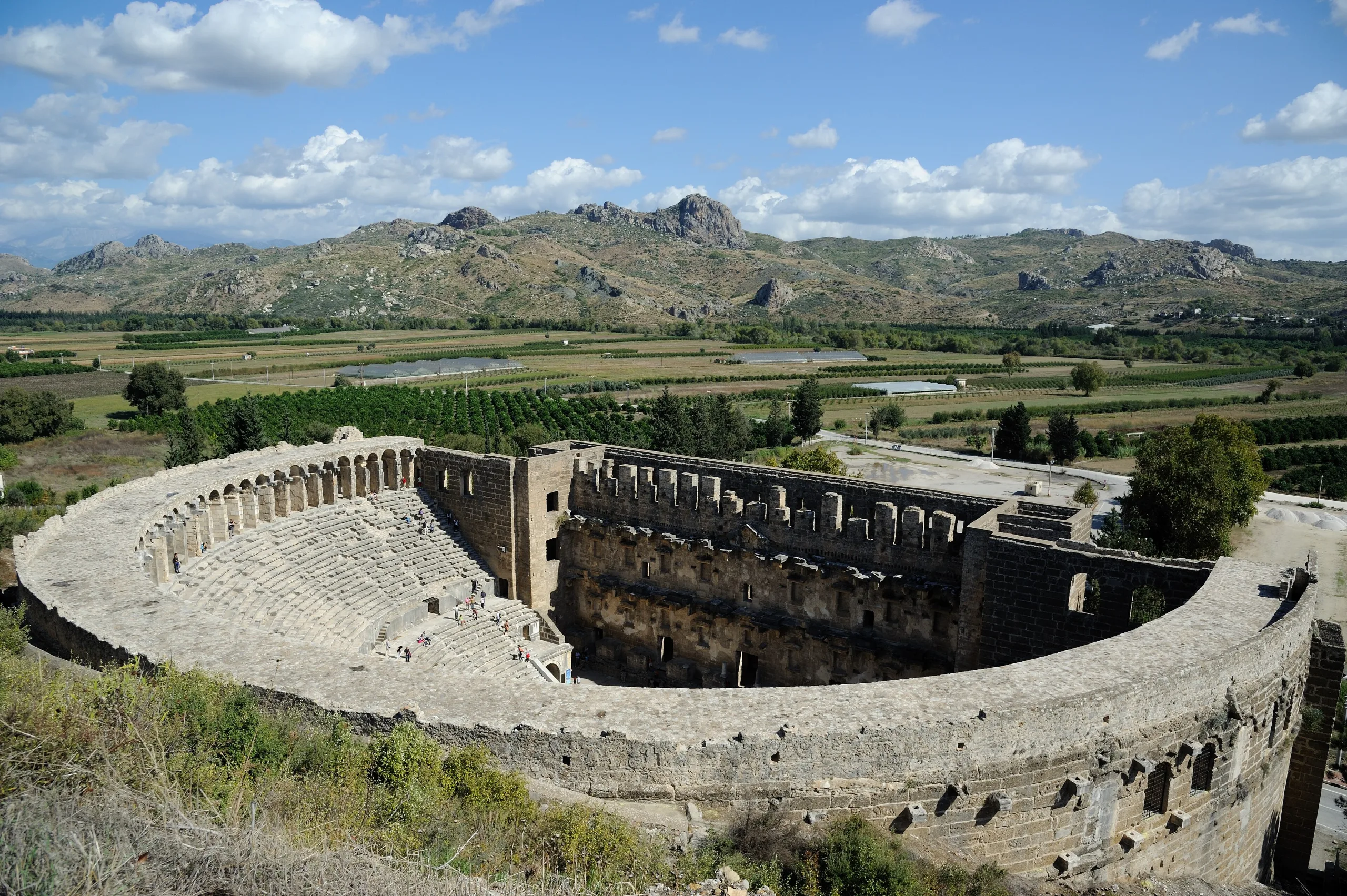
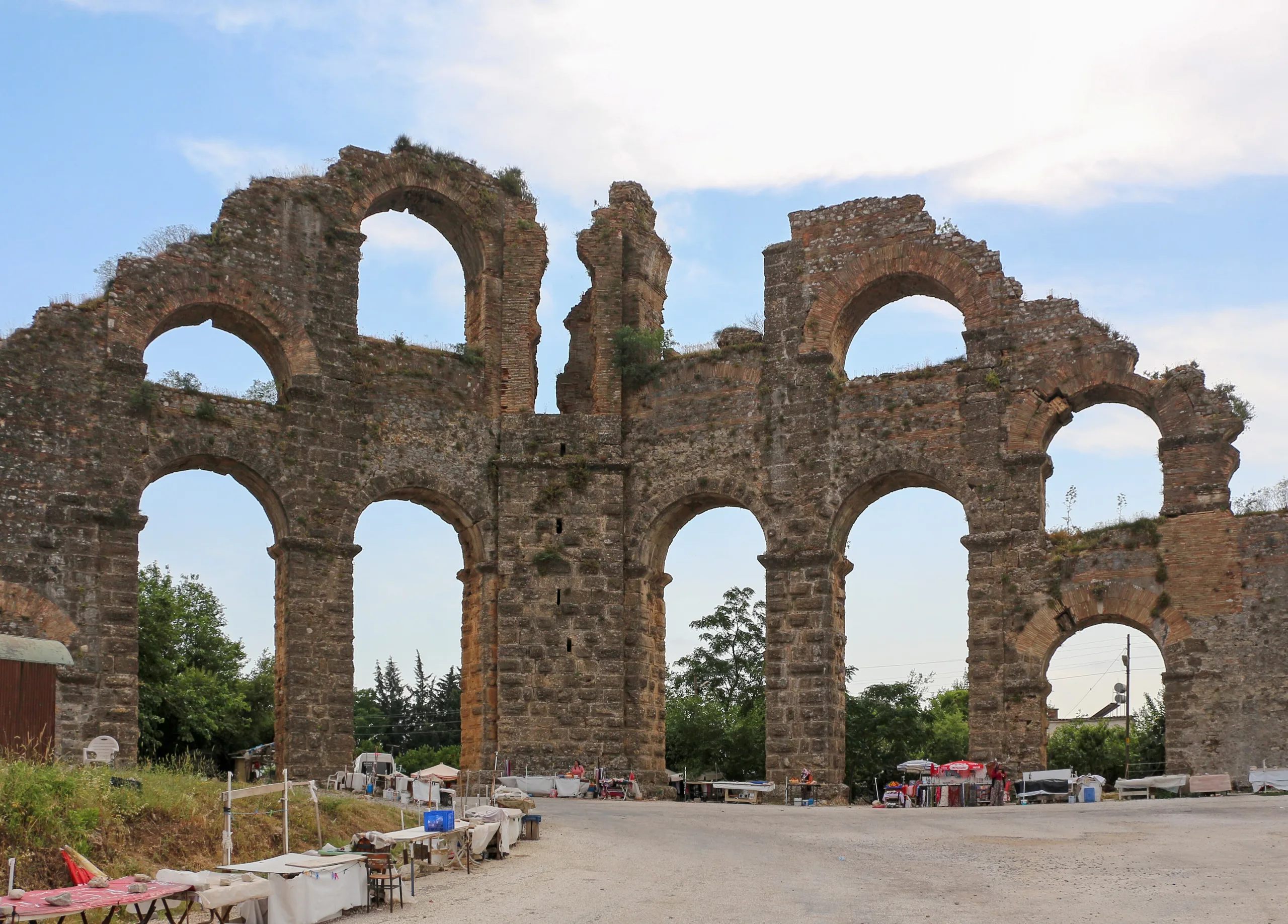
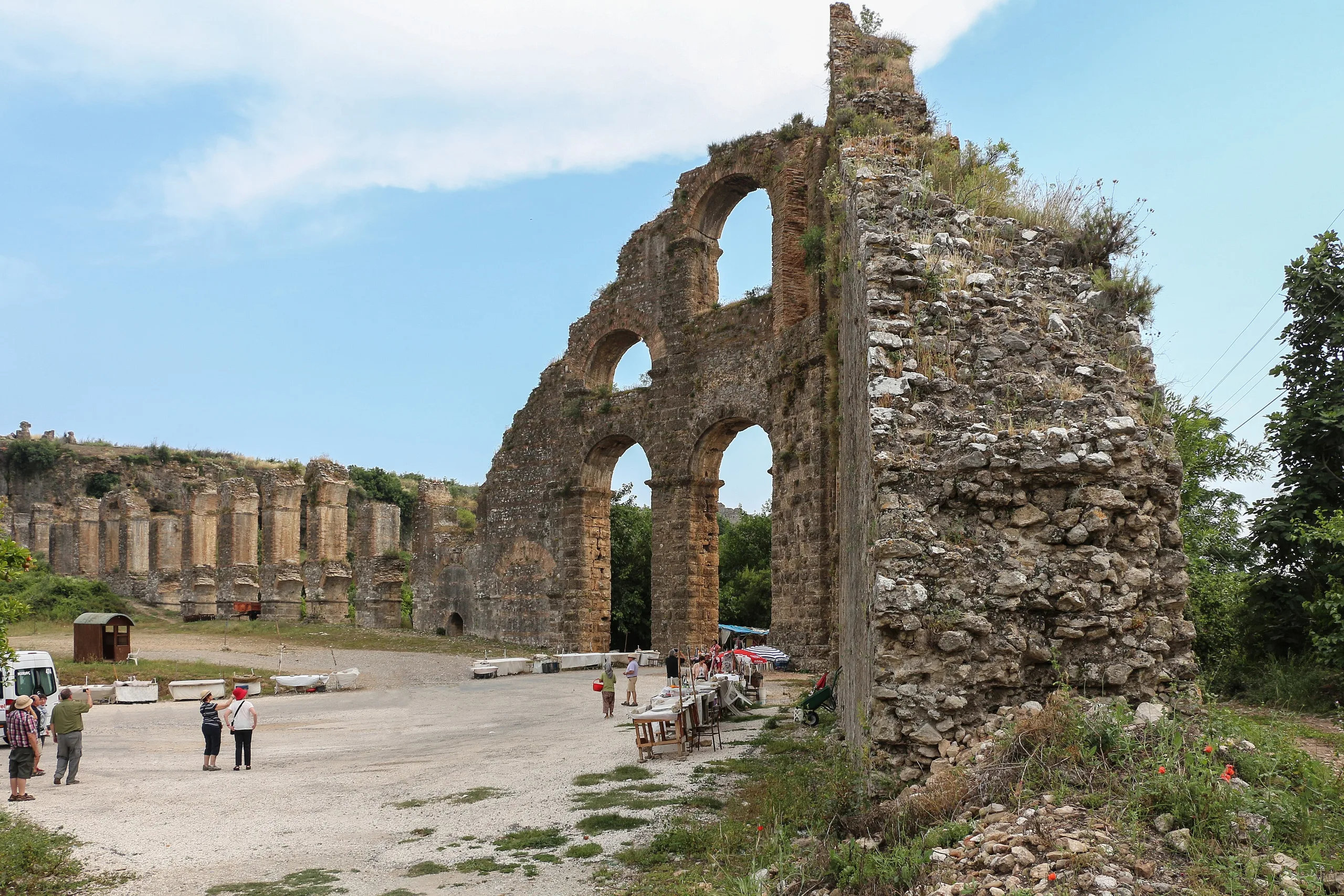
The two-storey stage building of the Aspendos theatre still stands to full height. This Pamphylian city near Serik also has an aqueduct arcade over a kilometre long.
Aspendos is an ancient city located in Turkey, Antalya. Main periods: Classical Period, Hellenistic Period, Roman Period, Seljuk Period, Iron Age.
The two-storey, five-door stage building of the Aspendos theatre still stands to its full height, after more than eighteen centuries. It owes this to the Seljuks, who turned the theatre into a palace for their sultan in the 13th century, so it was used and repaired rather than left to fall. Aspendos stands on a hill beside the Köprüçay (ancient Eurymedon) in the Belkıs neighbourhood of Serik district, Antalya, and its second surprise is a chain of arches, over a kilometre in total, that once carried water up to the hill.
The city flourished under Rome, especially in the 2nd century CE. Some dates and measurements of its monuments are debated among researchers, and the figures that look most secure are given below.
Setting
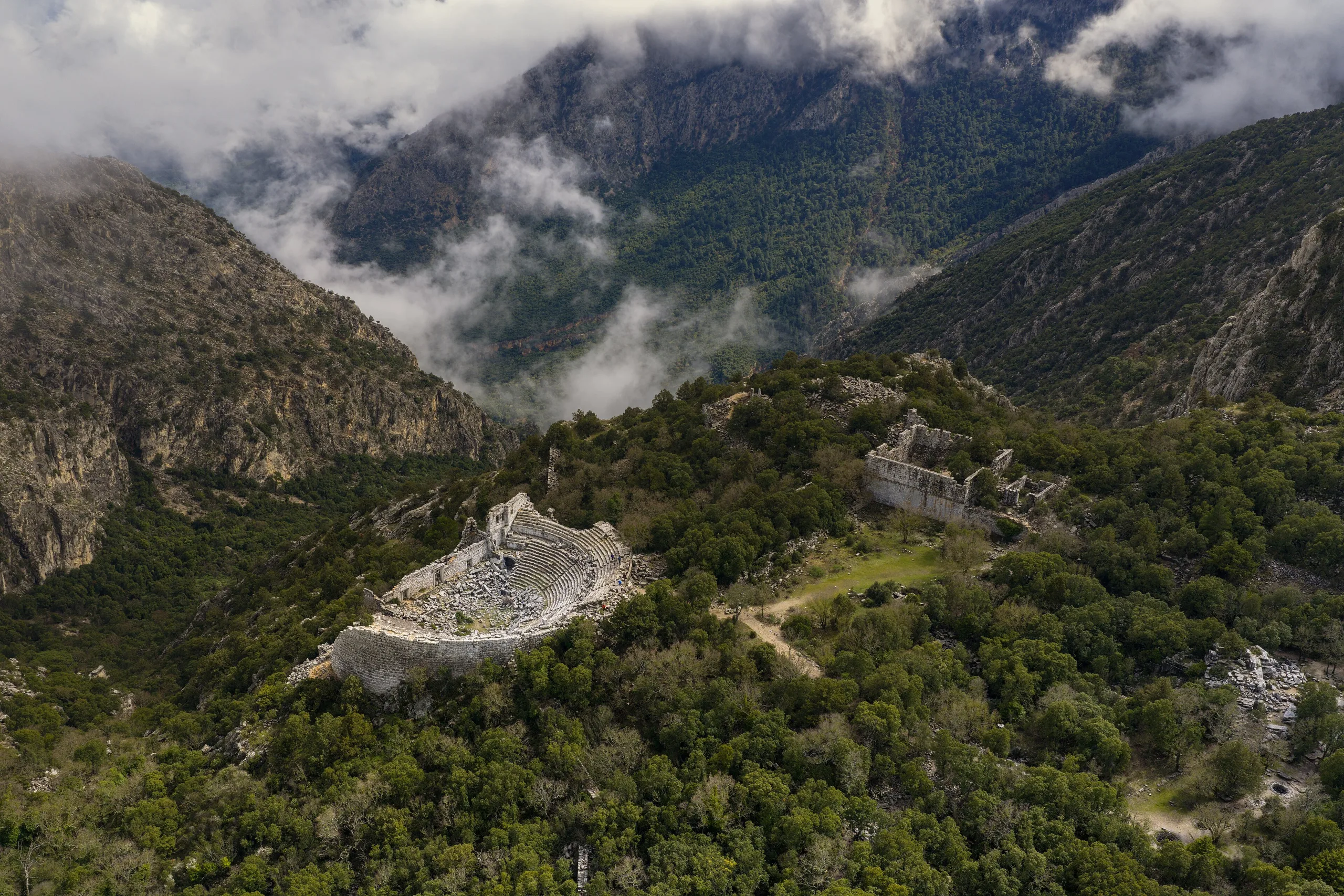
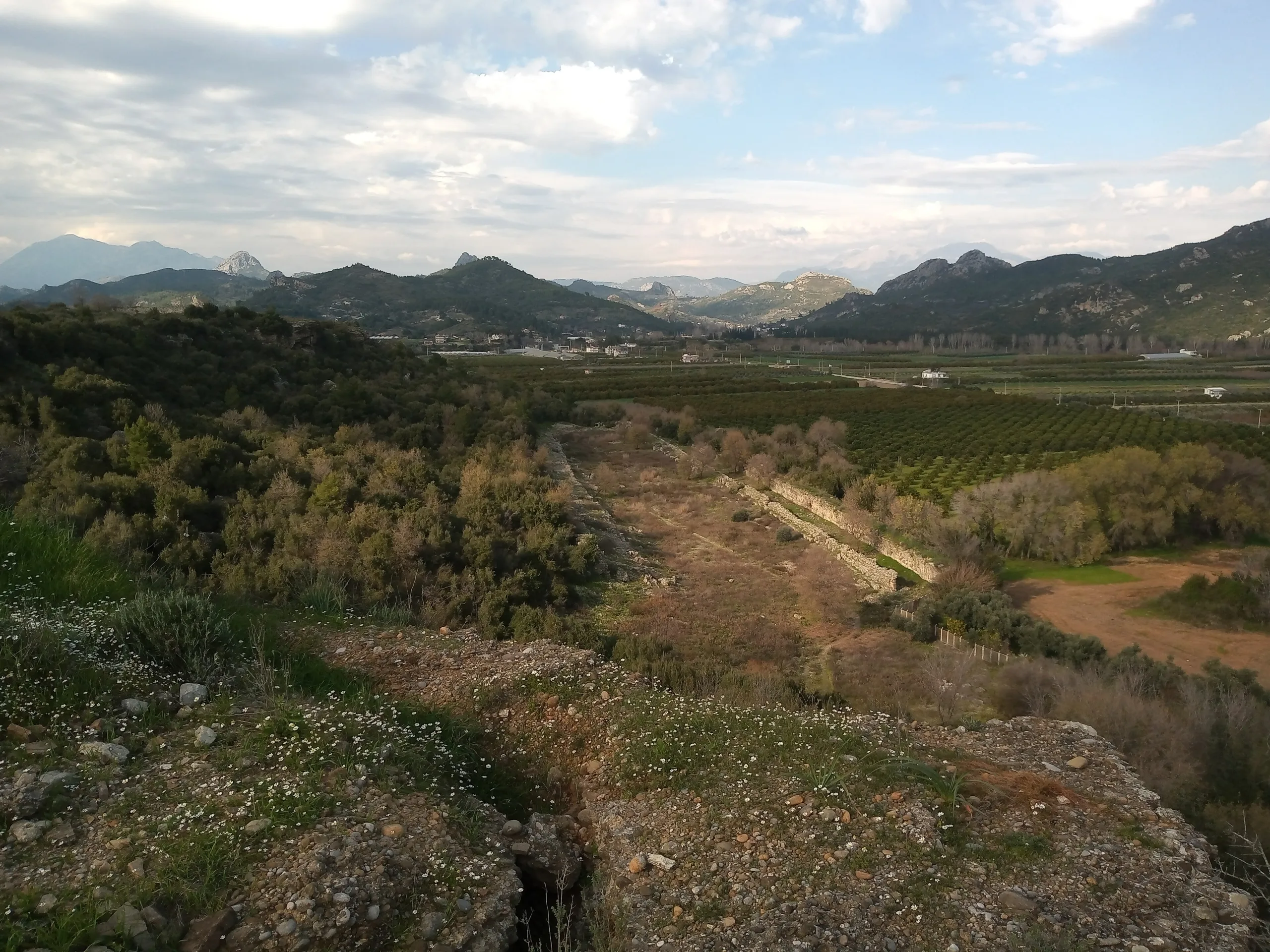
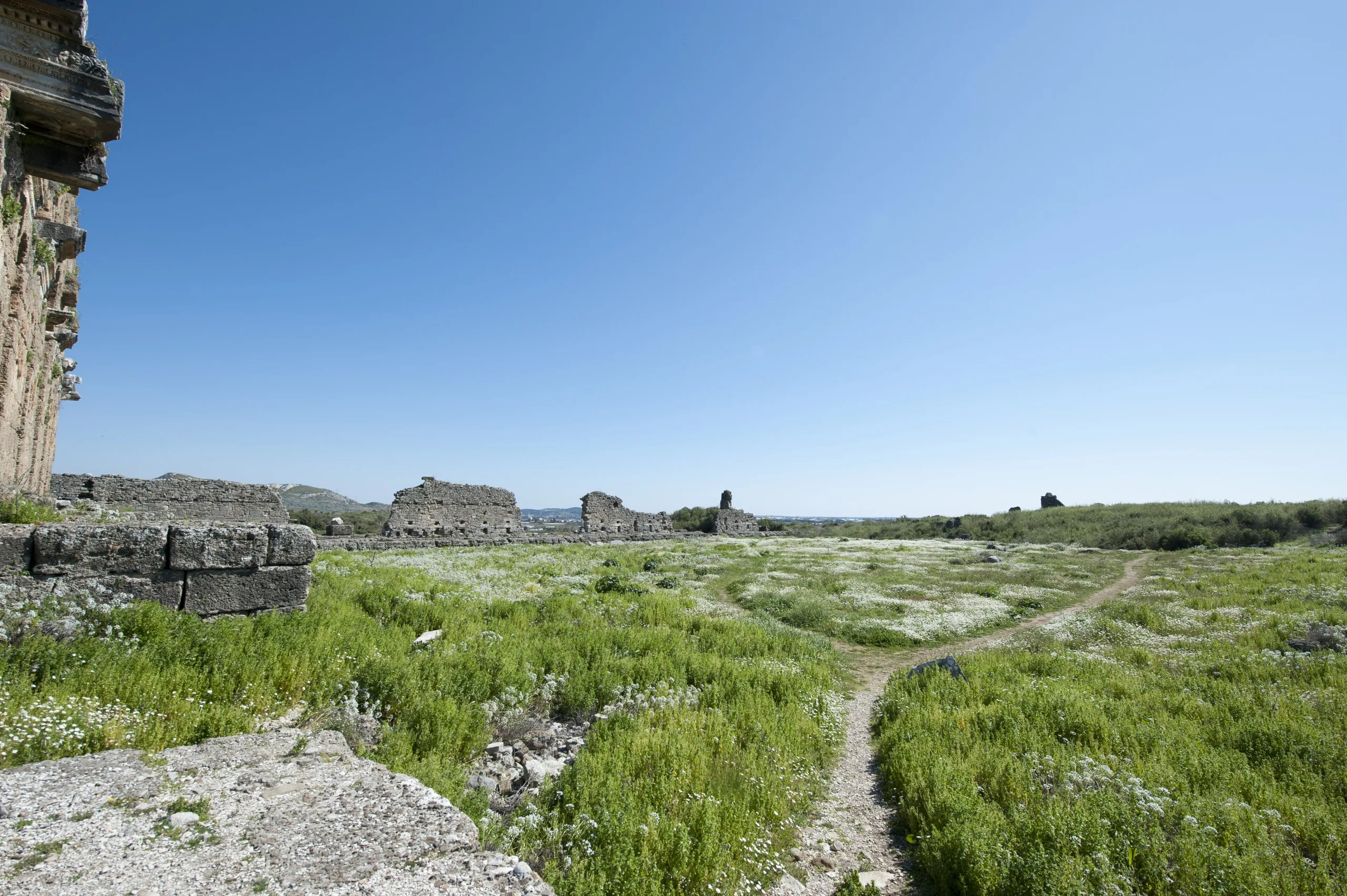
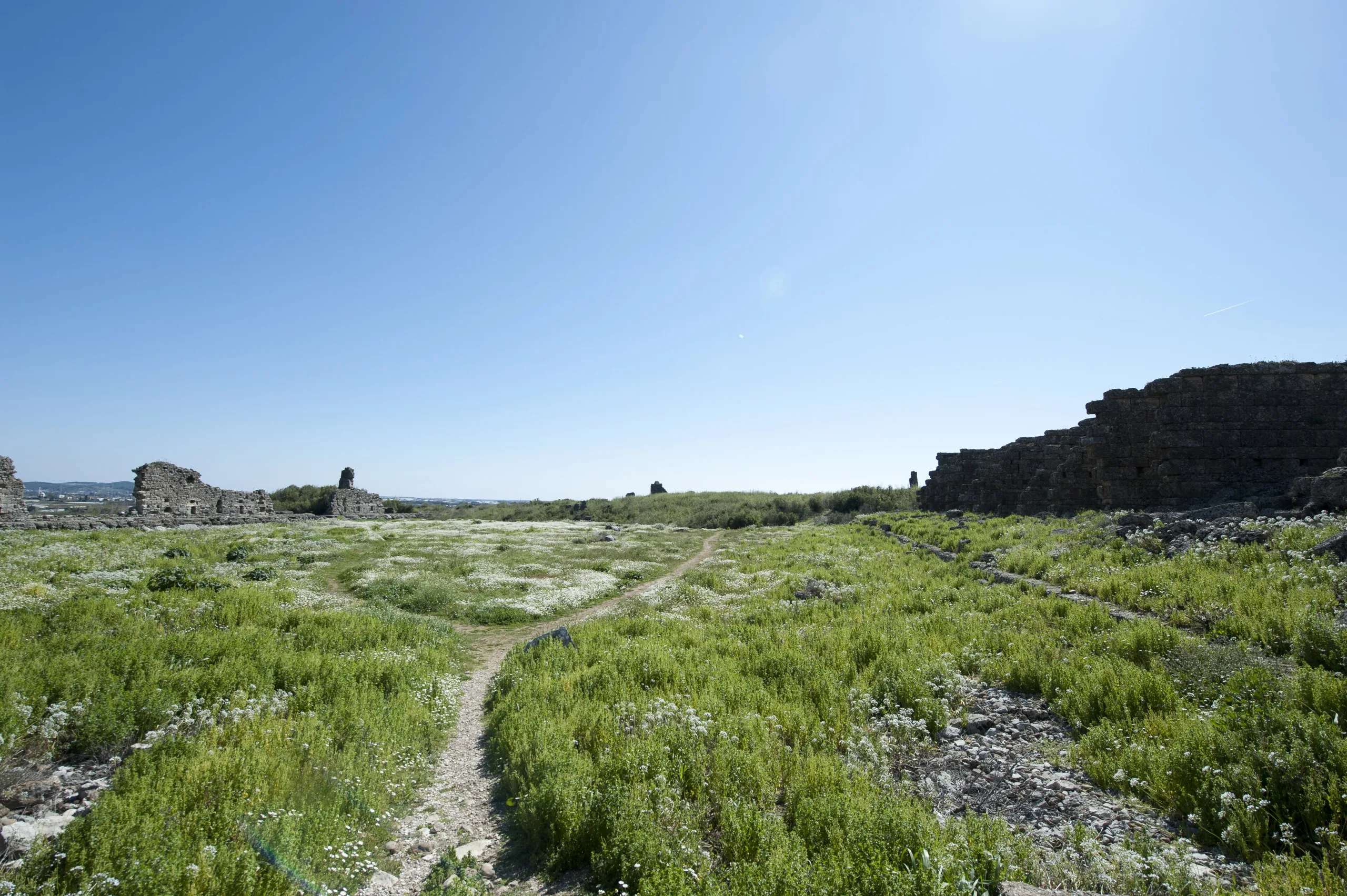
Aspendos lies about 48 km north-east of the centre of Antalya on a high hill beside the Köprüçay, and over time it spread around the hill. The Eurymedon used to be navigable, and the city's prosperity rested largely on that. The acropolis is a flat-topped rock roughly 60 m above sea level. The city had two parts: the theatre and a stadium lie in the Lower City, while the acropolis, agora, basilica, monumental fountain and odeon belong to the Upper City.
History
Aspendos was one of the first cities of the region to strike coins in its own name. Greek legend ties it to Argive settlers who came under Mopsos after the Trojan War. Some place the foundation with the seer Mopsos in the 13th-12th centuries BCE, while Strabo credits the Argives, and recent research has reached Early Iron Age layers, pushing the story back further still. The name read as Estvediys on Classical coins has been linked to Asitawandas, known from bilingual inscriptions of the second half of the 8th century BCE at Karatepe.
Little is known of the Lydian years. When the Persians ended Lydian rule in 547/546 BCE, Aspendos came under Persian control, yet it went on minting its own silver in the Classical period. Kimon destroyed the Persian fleet at the mouth of the Eurymedon in 468 BCE, and around then the city briefly joined the Attic-Delian League. An Athenian inscription of 425 BCE lists it among tax-paying cities. In 333 BCE it passed to the king of Macedonia; the story goes that it first tried to resist Alexander the Great by trickery, then gave in and agreed to supply its famous horses and a tax paid in gold.
After Alexander's death the city lay in a region that changed hands between Ptolemies and Seleucids, and under Rome it stayed an independent city-state. Gaius Verres sacked Aspendos in 79 BCE, as he did other Pamphylian cities. Pamphylia belonged to Cilicia until 43 BCE; after 31 BCE Augustus attached it to Galatia; and in 74 CE Vespasian created the joint province named Lycia et Pamphylia, and Aspendos was part of it.
Under Roman rule, thanks above all to building work in the 2nd century CE, it ranked among the grandest cities of the region. Olive oil, grain, textiles, wine, salt from a lake close by, and horse breeding made up its trade. It stayed lively into the Christian era and in the 5th century, under Archbishop Tribonianus, took the name Primoupolis. In the 13th century the theatre was converted into a palace for Sultan Alaeddin Keykubad. Mustafa Kemal Atatürk visited in 1930 and ordered that the building be repaired and used again, and Turkey's first theatre festival was held at Aspendos in 1959.
Notable structures
The theatre
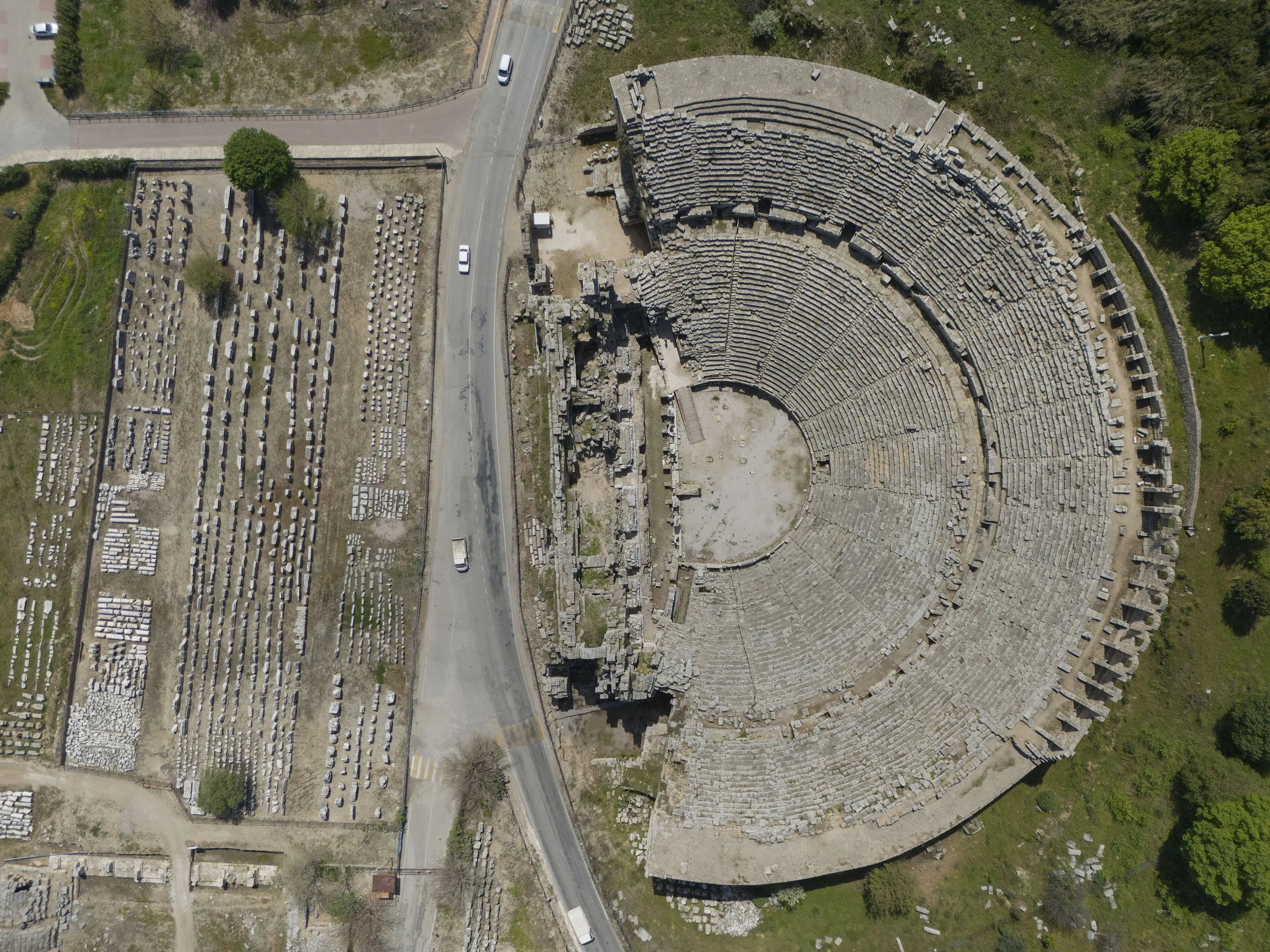
An inscription on the west entrance wall dates the theatre to the reign of Marcus Aurelius, roughly 160-180 CE. Its architect was Zenon, son of Theodorus, and its donors were two wealthy brothers, A. Curtius Crispinus and A. Curtius Crispinus Arruntianus. Most of the cavea, the semicircle of seats, is cut into the east slope of the acropolis and the remainder rests on arches and vaults. A horizontal passage called the diazoma divides it into a lower part with 20 rows and an upper part with 21.
The stage-building facade is about 100 m wide and 22 m high. The covered gallery running around the top of the cavea is the best-preserved of its type in Asia Minor. Older estimates of the seating ranged from 12,000 to 20,000; recent studies, allowing 45 cm of seat width per person, arrive at 7,300-7,600, and at most 8,500 for crowded events where the steps were used as seats. Red zigzag paint from the Seljuk repair can still be made out on the surfaces, and some tiles of that period are displayed in the Antalya Ethnography Museum.
The aqueducts
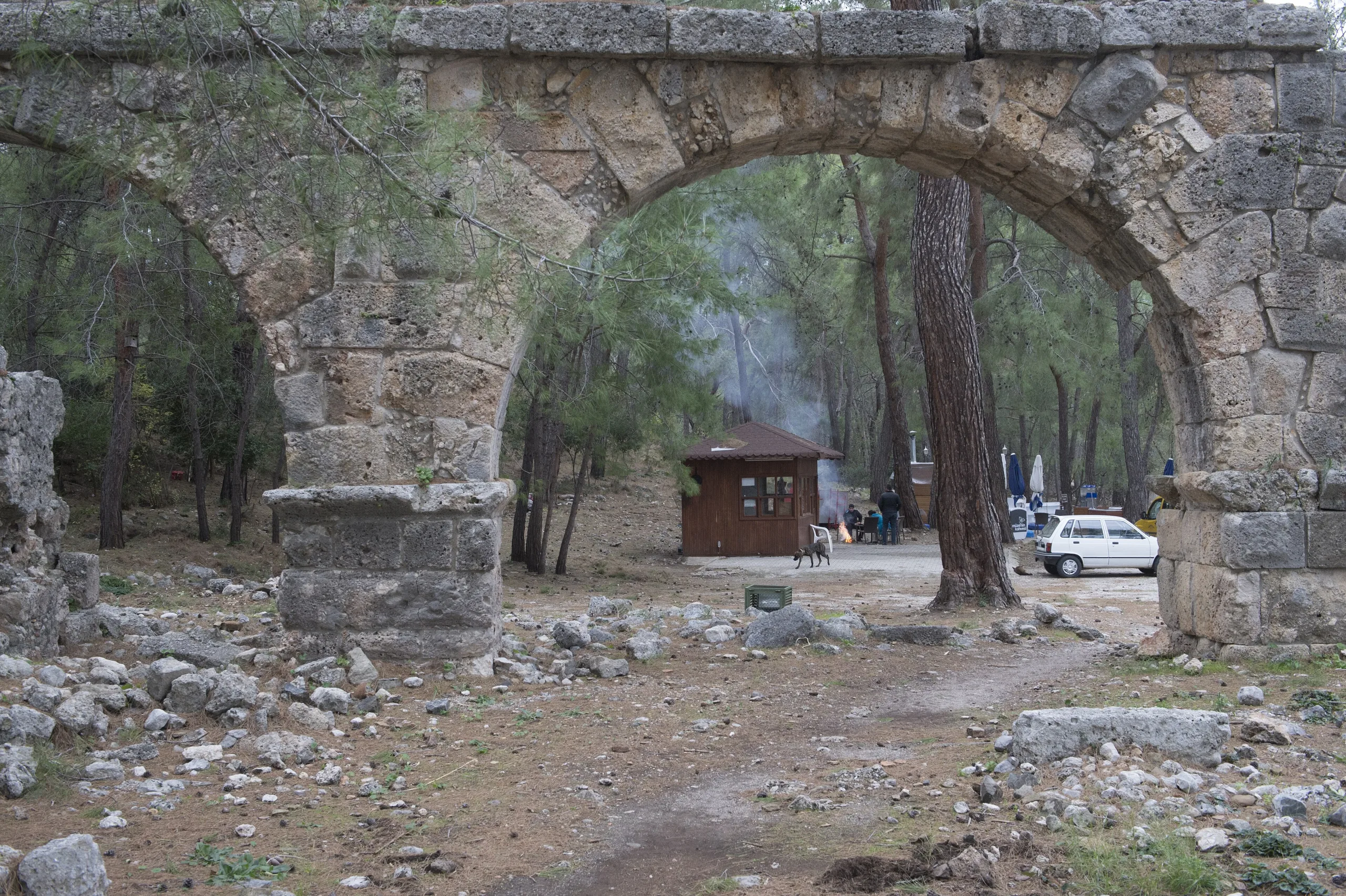
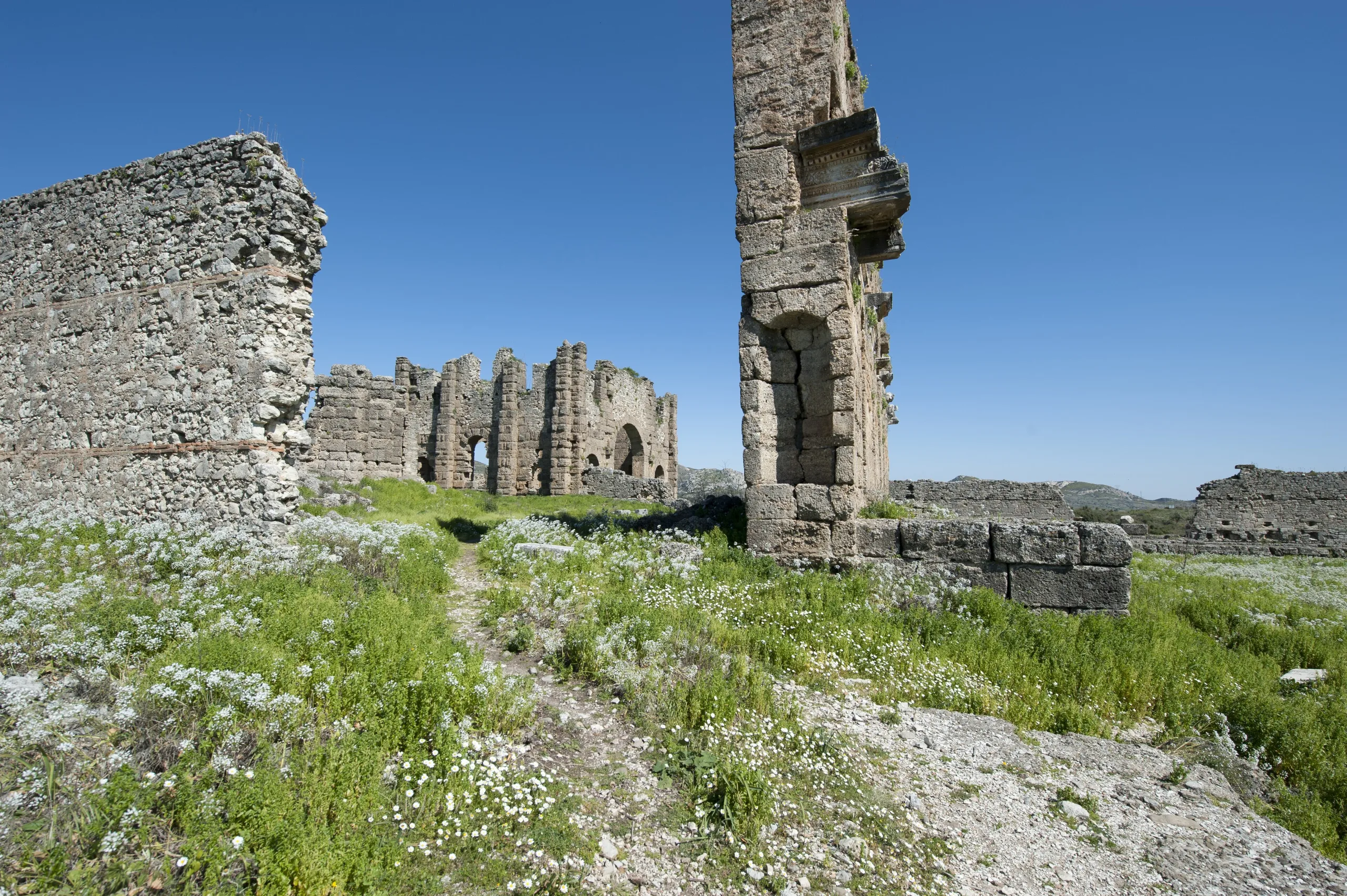
An arcade of about one kilometre carries water to the acropolis, which comes from the mountains to the north by a line of some 19 km from the Gökçeler and Pınarbaşı springs. The system includes two inverted siphons. An inverted siphon sends water down one side of a valley and, under pressure, back up the other. The siphon towers, about 30 m high, cross a valley 1.7 km wide; arches of 5.5 m span cover the 924 m between the towers and reach 15 m in height at the deepest point. The channels themselves are 55-60 cm in width and 90 cm tall. On the strength of an epigraphic record, Bean argued that Tiberius Claudius Italicus had the aqueducts built in the 2nd century CE for two million denarii. The mixture of brick, cut stone and mortared rubble is unusual in Asia Minor.
The Upper City
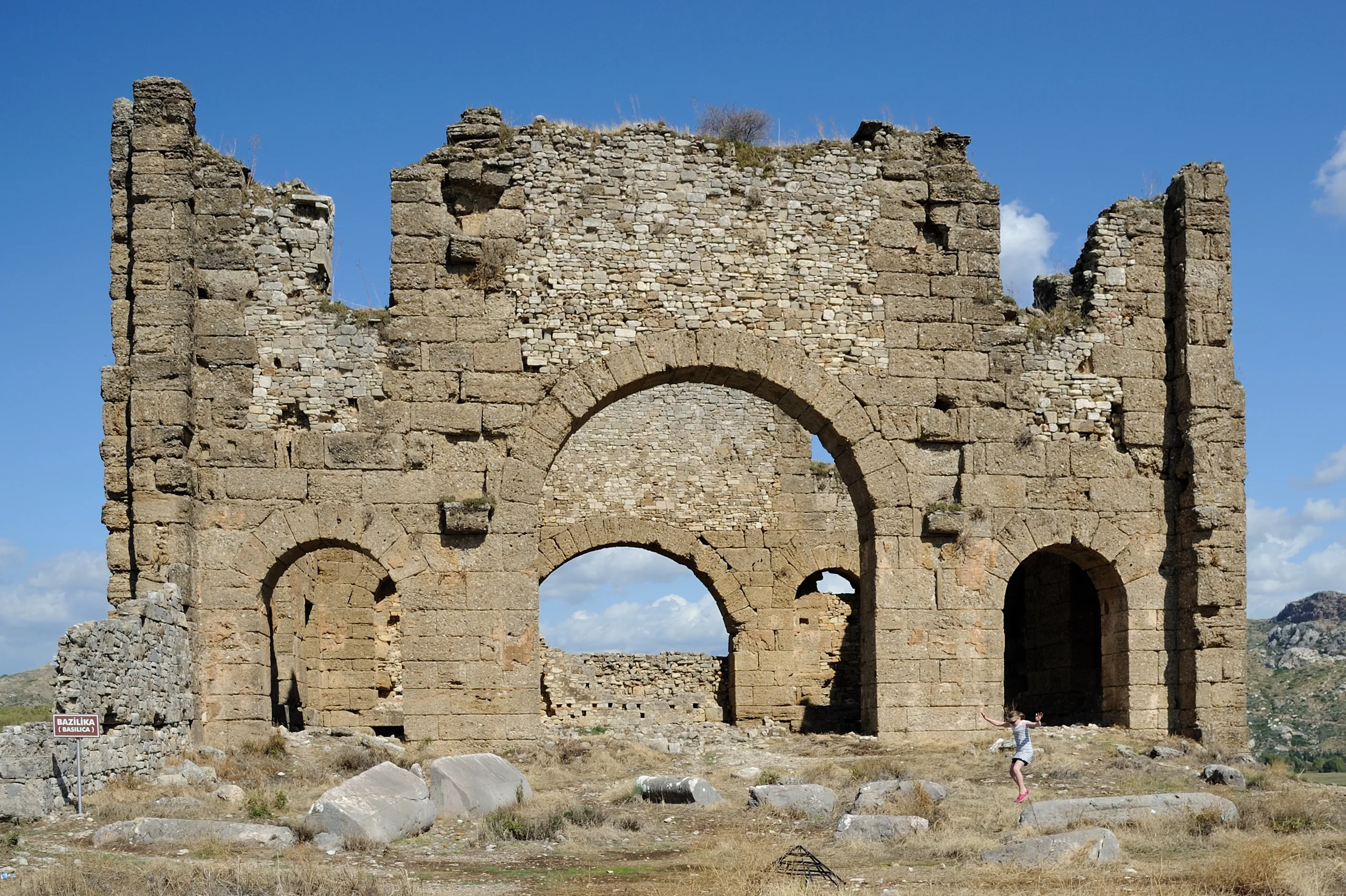
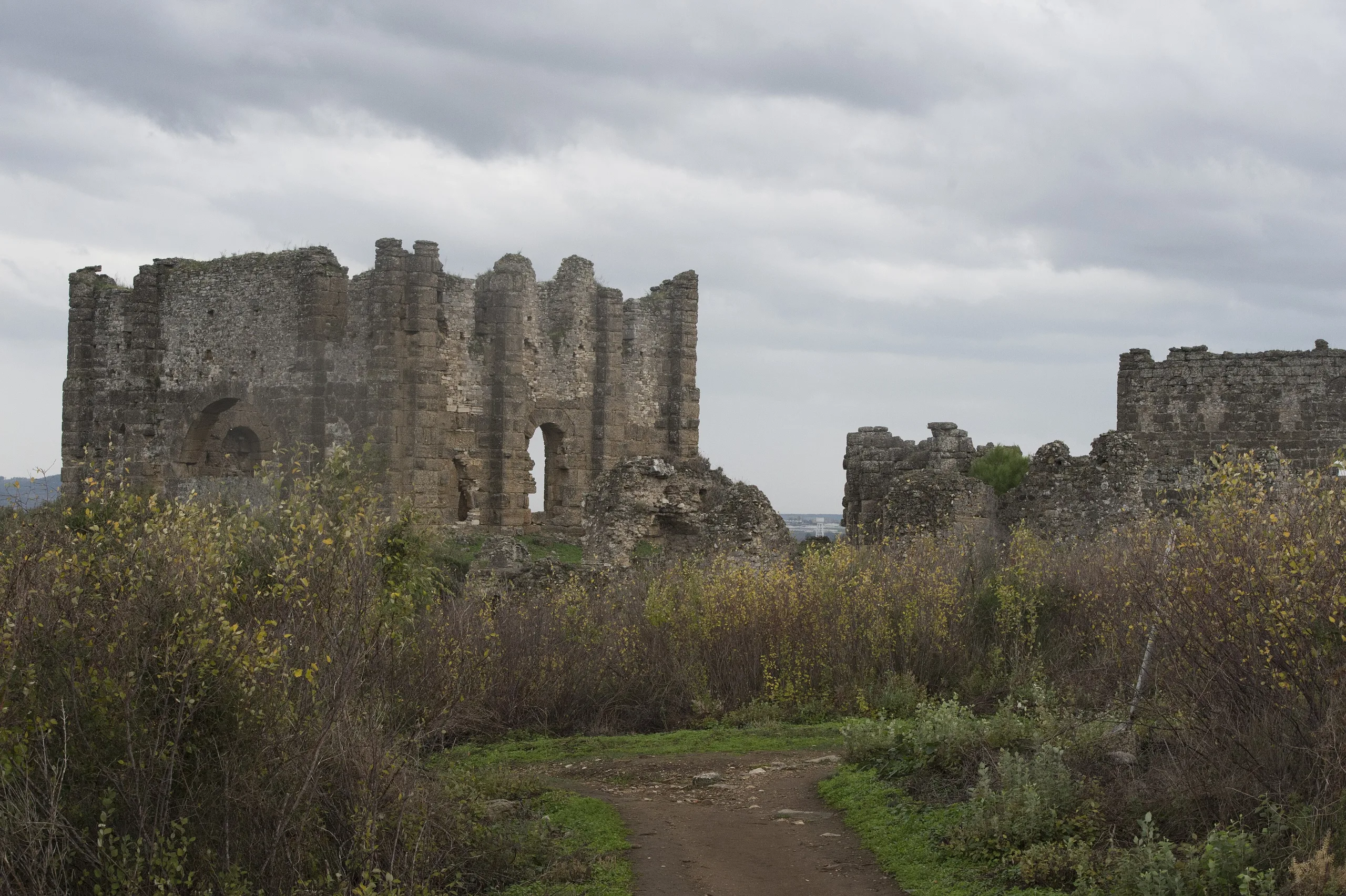
On the acropolis stand the agora, a basilica 100 m long, a monumental fountain (nymphaeum) 35 m long and 15 m high, a market building, and the odeon behind the fountain, a small roofed hall for concerts and meetings. Cüppers studied the basilica's granaries in 1958 and Lauter the Hellenistic Agora in 1968.
Excavation history
Travellers such as Beaufort, Fellows, Schönborn and Texier described the city from the 19th century onward, and the most important research was carried out by a team under Lanckoroński in 1884. Italian archaeologists applied to dig in 1913 but never received a permit. Hörmann studied the Nymphaeum in 1929 and Ward-Perkins the aqueducts in 1955. Recent decades have concentrated on the aqueducts and the bridge of Roman-Seljuk date across the Eurymedon. In 2008 a team under Veli Köse of Hacettepe University began surveys around the city and started recording the theatre and other public buildings with digital technology.
Excavation began in 2013 under the Antalya Museum. In 2014, by a decision of the Council of Ministers, it became a scientific project under Veli Köse and ran until 2021. Since 2022 it has continued under Mustafa Bilgin of Afyon Kocatepe University, and in the same year a survey project to define the boundaries of Aspendos' territory was launched.
A legend
One story sets the aqueduct against the theatre. The ruler of Aspendos declared that his daughter would marry whoever did the city the greatest service; of two brothers, one built the aqueduct and the other the theatre. The king leaned toward the aqueduct, which brought water from distant mountains, but then marvelled at the theatre's acoustics: standing at the far end of the stage, he heard the architect's whisper and gave the prize to the theatre.
World Heritage and protection
Turkey proposed the Theatre and Aqueducts of Aspendos for the UNESCO World Heritage Tentative List on 13 April 2015 under criteria (i), (ii) and (iv) (reference 6036). The site has been protected as a first-degree archaeological and third-degree natural site since 8 September 1994.
Visiting
The site is in the Belkıs neighbourhood, and the Müzekart is valid for Turkish citizens only. For current hours and fees, check the official museum page.
Gallery
Frequently asked questions
Where is Aspendos?
When was the Aspendos theatre built?
How many people did the theatre hold?
Why is the theatre so well preserved?
Why are the aqueducts important?
Is Aspendos a World Heritage Site?
Sources (14)
- Aspendos Örenyeri / Aspendos (TR ve EN sayfalar) — T.C. Kültür ve Turizm Bakanlığı, Müzeler ve Ören Yerleri
- Aspendos (Türkiye Kültür Portalı) — T.C. Kültür ve Turizm Bakanlığı, Antalya İl Kültür ve Turizm Müdürlüğü
- The Theatre and Aqueducts of the Ancient City of Aspendos (Tentative List 6036) — UNESCO Dünya Miras Merkezi
- Aspendos Araştırma ve Kazıları: Tarihçe (History) — Aspendos Kazı Başkanlığı (Afyon Kocatepe Üniversitesi)
- Aspendos/Primoupolis (Pleiades place 638776) — Pleiades
Photo credits
- Photo: Saffron Blaze, CC BY-SA 3.0 — Wikimedia Commons (resized)
- Photo: Saffron Blaze, CC BY-SA 3.0 — Wikimedia Commons (resized)
- Photo: Olos88, CC0 — Wikimedia Commons (resized)
- Photo: Bernard Gagnon, CC BY-SA 3.0 — Wikimedia Commons (resized)
- Photo: Bernard Gagnon, CC BY-SA 3.0 — Wikimedia Commons (resized)
- Photo: Dosseman, CC BY-SA 4.0 — Wikimedia Commons (resized)
- Photo: Dosseman, CC BY-SA 4.0 — Wikimedia Commons (resized)
- Photo: Dosseman, CC BY-SA 4.0 — Wikimedia Commons (resized)
- Photo: Dosseman, CC BY-SA 4.0 — Wikimedia Commons (resized)