Hadrianopolis is a Paphlagonian city in Eskipazar, Karabük, inhabited in Roman and Early Byzantine times and known for its mosaic-floored churches and Saint Alypius.
Hadrianopolis is an ancient city located in Turkey, Karabuk. Main periods: Hellenistic Period, Roman Period, Byzantine Period.
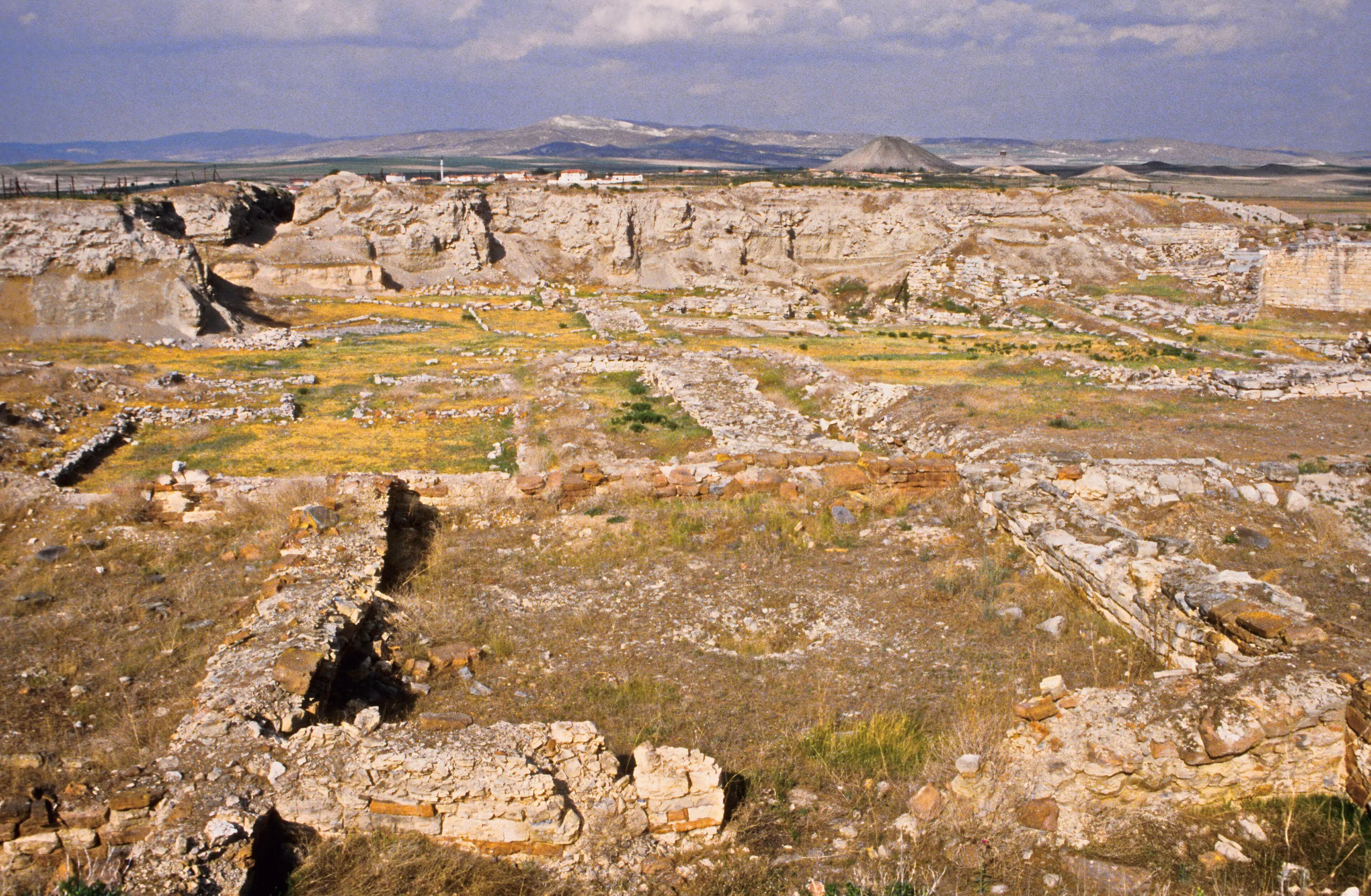
Hadrianopolis lies about 3 km west of the centre of Eskipazar district in Karabük Province, in the locality called Viranşehir and on the land around it. The settlement is scattered over the territory of four villages, Budaklar, Büyükyaylalar, Çaylı and Beytarla, with the remains clustering in the Hacı Ahmetler quarter of Budaklar. The Ministry places it where Paphlagonia, Bithynia and Galatia meet, north-east of Krateia. Pleiades lists the city under the names Kaisareia, Hadrianopolis and Proseilemmene.
History
The Ministry says that surveys and excavations running since 2003 show the city to have been a significant market on Paphlagonia's trade routes in the Roman period, which explains why people kept living there. The abstract of a DergiPark article places occupation in the Late Hellenistic, Roman and Early Byzantine periods and finds the town closer in character to inland than to coastal Paphlagonian cities. It also notes that inscriptions point to the 1st to 3rd centuries CE while excavated architecture has not yet confirmed that range.
The settlement was part of the province of Galatia in 5 BCE, called Kaisareis Proseilemmentiai; starting in the 2nd century CE the name became Kaisareis Hadrianopoleitai. The Ministry says it is unclear whether Hadrian himself renamed it, but an inscription proves an imperial cult there, naming Hadrian, Trajan and Nerva. The surviving remains suggest the city gained real weight in the Late Roman and Byzantine eras. Its Byzantine territory stretched as far as modern Karabük, and at some unknown date a city called Sora was founded and split off from it. Early on it lay in Paphlagonia; under Theodosius I (379-395) it was moved to the new province of Honorias, and in 535 it returned to Paphlagonia for civil purposes while remaining ecclesiastically tied to Honorias.
The Ministry singles out Saint Alypius, who came to the city aged 32 and spent about fifty years on a column in the old necropolis; a women's monastery for Saint Euphemia is said to have stood nearby. Umayyad raids on neighbouring Gangra in the 720s CE hurt Hadrianopolis and set the stage for its gradual abandonment, and little material later than the 8th century has been found. Afterwards the area came under the Oghuz, the Anatolian Seljuk state, the Candaroğlu beylik and finally the Ottomans.
Notable remains
The Culture Portal describes several centres within the city. In one, Roman remains cluster around a sacred area with an aedicula cut into a rock face; otherwise Roman architecture is scarce. Early Byzantine remains are dense: three church ruins stand inside the city, two of them opened by looters, along with a cistern whose vaults still stand. All three churches belong to the 6th century CE. The DergiPark abstract adds that the baths occupy two terraces, that the buildings use marble and travertine brought from nearby quarries, and that Phrygian influence shows in burial customs, in details of the Church B mosaics and in pottery.
The earliest church, 2 km away from the town of Eskipazar, measures 15 by 23.5 metres, and work since 2003 has uncovered four notable mosaics on its floor. Figures of women, men, animals and fruit appear, and the four rivers of paradise, Phison, Geon, Euphrates and Tigris, are personified and labelled; the Portal says no similar composition is known from elsewhere in Anatolia. A dedicatory inscription in the floor mentions Himerios, a loyal palace guard, and Valentina, and research found the name Himerios attested only in the 6th century CE. On the outer face of the atrium wall is a Greek inscription of at least ten lines that was chiselled out but remains legible, and at the entrance a marble inscription says Iordannes lies among the saints. The mosaics were covered with a temporary protective sheet in 2003.
Visiting
The Ministry's page gives the address of the excavation house in Budaklar. For hours, entry terms and the site's current status, see the official page.
Frequently asked questions
Where is Hadrianopolis?
Where does the name come from?
When did excavations start?
Which periods does the city represent?
What is special about the mosaics?
Who was Saint Alypius?
Sources (4)
- Hadrianopolis Örenyeri / Hadrianopolis (TR ve EN sayfalar) — T.C. Kültür ve Turizm Bakanlığı, Müzeler ve Örenyerleri
- Hadrianapolis Antik Kenti - Karabük — T.C. Kültür ve Turizm Bakanlığı, Türkiye Kültür Portalı
- Hadrianopolis Topoğrafyasının ve Doğal Kaynaklarının Kentteki Etkileri (2017-2020 Sezonları) (özet) — Avrasya Beşeri Bilim Araştırmaları Dergisi, DergiPark
- Kaisareia/Hadrianopolis/Proseilemmene (Pleiades 844959) — Pleiades