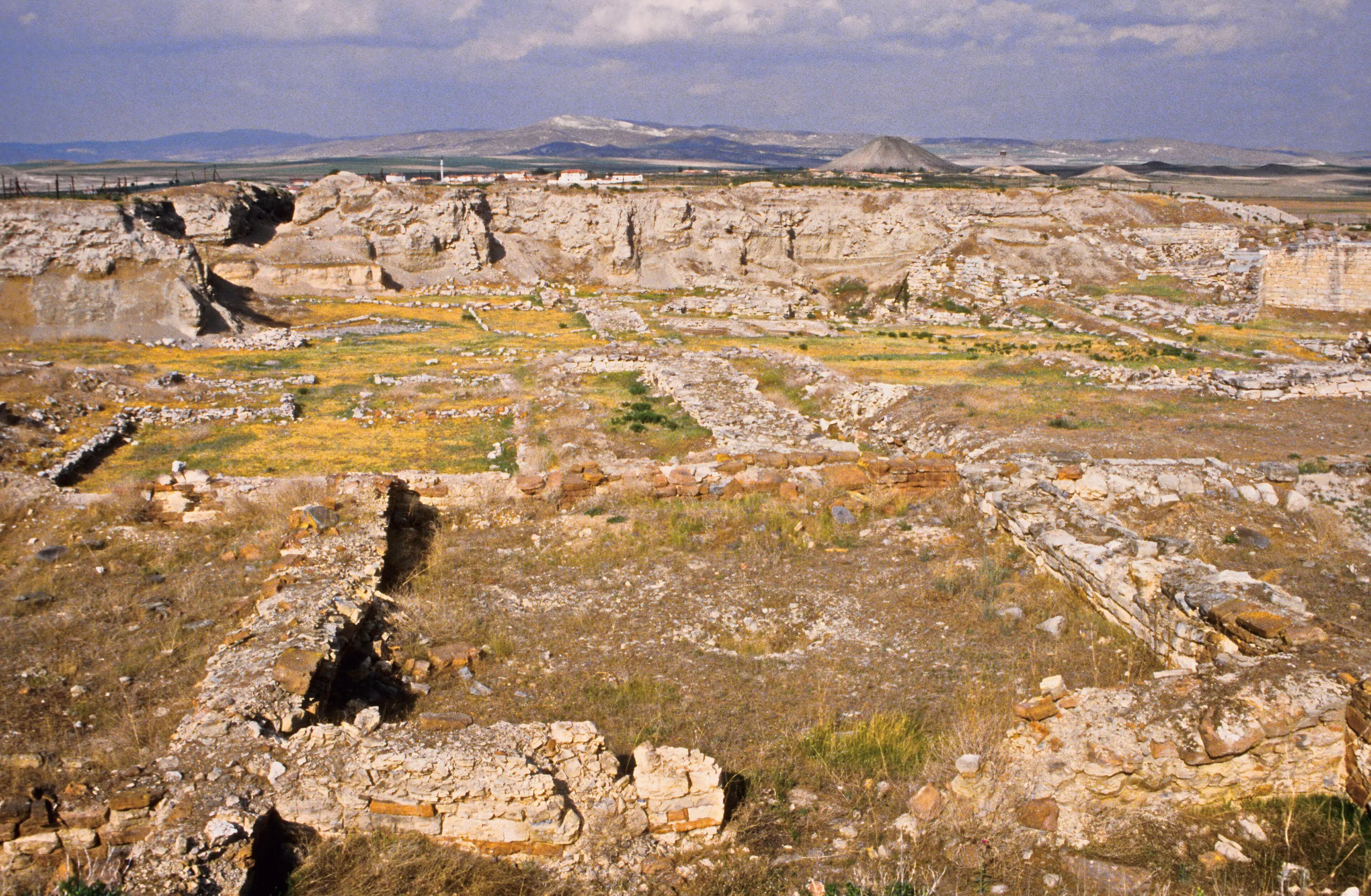
Gordion near Polatlı was Phrygia's royal seat; the 300 m wide Midas Mound holds the oldest known upright timber building. It joined the World Heritage List in 2023.
Gordion is an ancient city located in Turkey, Ankara. Main periods: Hellenistic Period, Roman Period, Bronze Age, Iron Age. It was inscribed on the UNESCO World Heritage List in 2023.
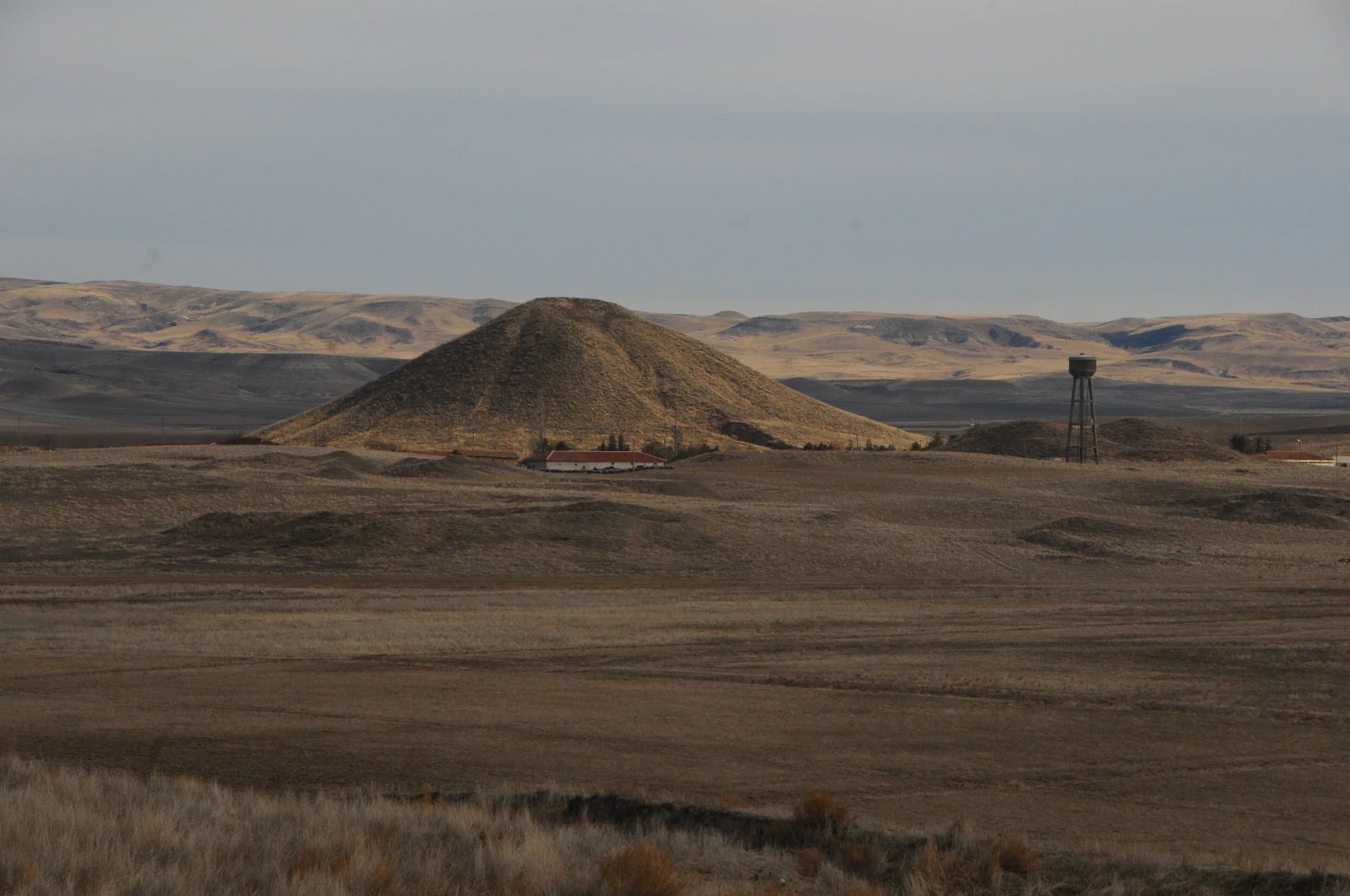
The Midas Mound measures 300 m across its base and rises 53 to 55 m above the plain, and inside it lies a wooden burial chamber dated to about 740 BCE. Regarded as the oldest upright timber building known anywhere, it was preserved for centuries by the earth heaped over it. The mound is the most striking monument of Gordion, beside Yassıhöyük village in Ankara's Polatlı district. Phrygia's kings ruled from Gordion, and the site, made up of the Citadel Mound, the Lower Town and well over a hundred tumuli (burial mounds covered in earth), was added to the UNESCO World Heritage List in 2023. It is considered the best surviving witness to Phrygian civilisation.
Location
Gordion lies on a steppe-like plain crossed by the Sakarya River from south to north. It is about 90 km south-west of Ankara and 18 km north-west of Polatlı, where the Sakarya and Porsuk rivers join, close to the Ankara-Eskişehir highway. The place has also gone by the names Gordium and Vindia.
History
On the nominated property occupation runs from 2500 BCE to 1400 CE, yet the main remains preserved in place belong to the Phrygian culture of the 10th to 6th centuries BCE. Excavations have found material reaching back to the Early Bronze Age (3000 BCE), and the settlement's total span exceeds 4,000 years. Bronze Age levels have been reached only in small test trenches. In its first phase Gordion lay under Hittite influence during the Late Bronze Age, until the Hittite empire collapsed around 1200 BCE. A revival followed in the Early Iron Age and peaked under King Midas around the 8th century BCE.
The Greeks called the kingdom Phrygia and the Assyrians Mushki, and Gordion was its royal capital. The urban area stretched over two kilometres and was ringed by more than a hundred tombs of the elite. Midas, known in legend for his ass's ears and golden touch, was a real ruler: Assyrian records show him still in power in 709 BCE, the last trustworthy news about him. The story told by Strabo, that Cimmerian invaders drove Midas to suicide, is viewed with suspicion.
A great fire on the Citadel Mound around 800 BCE left a thick layer of burnt debris that also preserved rich finds in the palace area. The Cimmerians are said to have destroyed the city early in the 7th century BCE, and the museum shows a destruction layer dated to about 700 BCE. After the fire the citadel was rebuilt to a single plan on a much higher level. Persian influence set in after the middle of the 6th century BCE. Alexander the Great is said to have wintered here in 333 BCE and cut the famous knot. By Hellenistic times, in the late 4th century BCE, Gordion had grown into a large, multi-ethnic town; its lively existence ended abruptly in 189 BCE, and in the 1st century CE it was refounded as a Roman colony with a military function. Byzantine and Ottoman presence marks later centuries, and the present village of Yassıhöyük was founded in the 1920s by families who came mostly from the Bolu area.
Principal monuments
The Citadel Mound
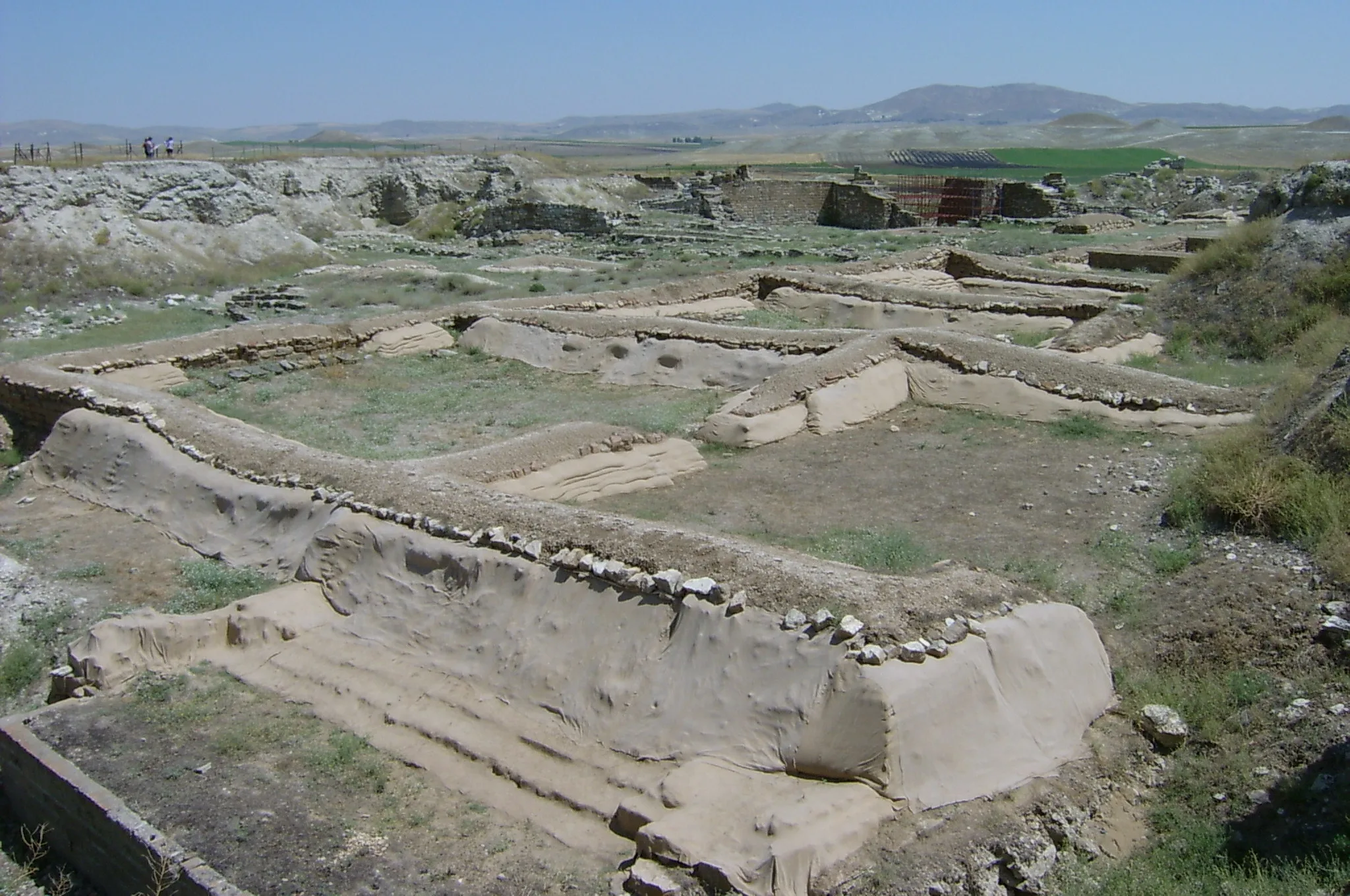
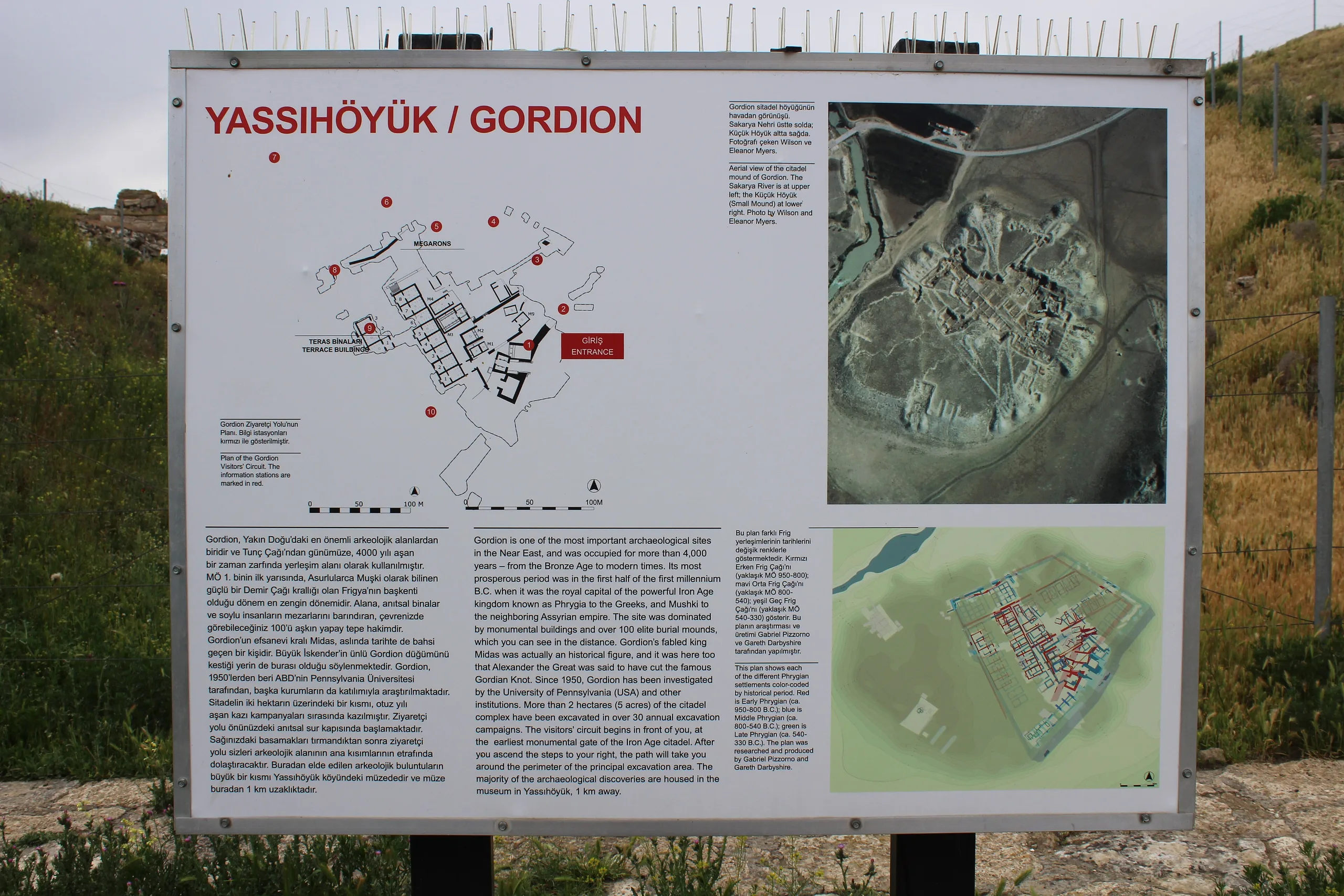
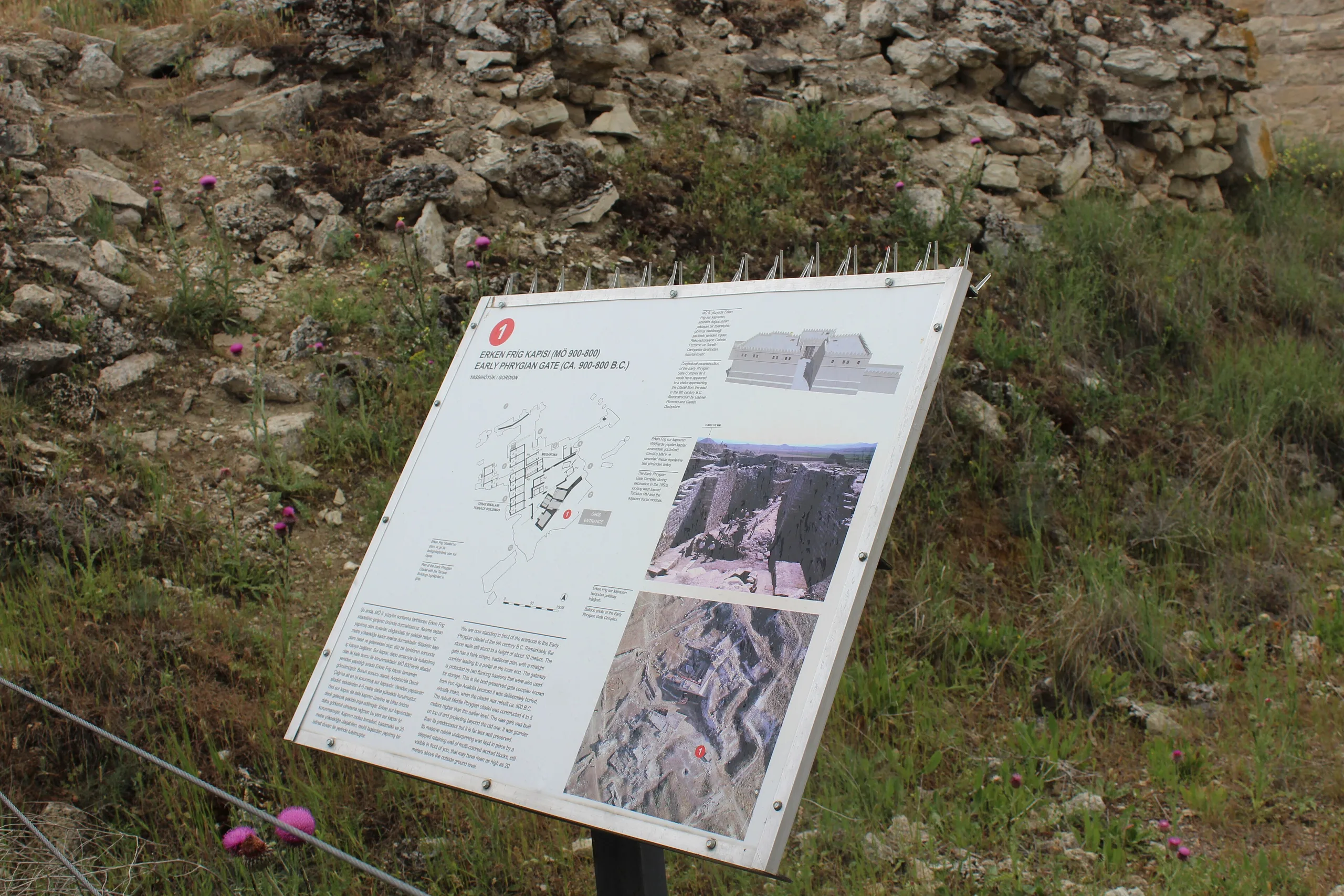
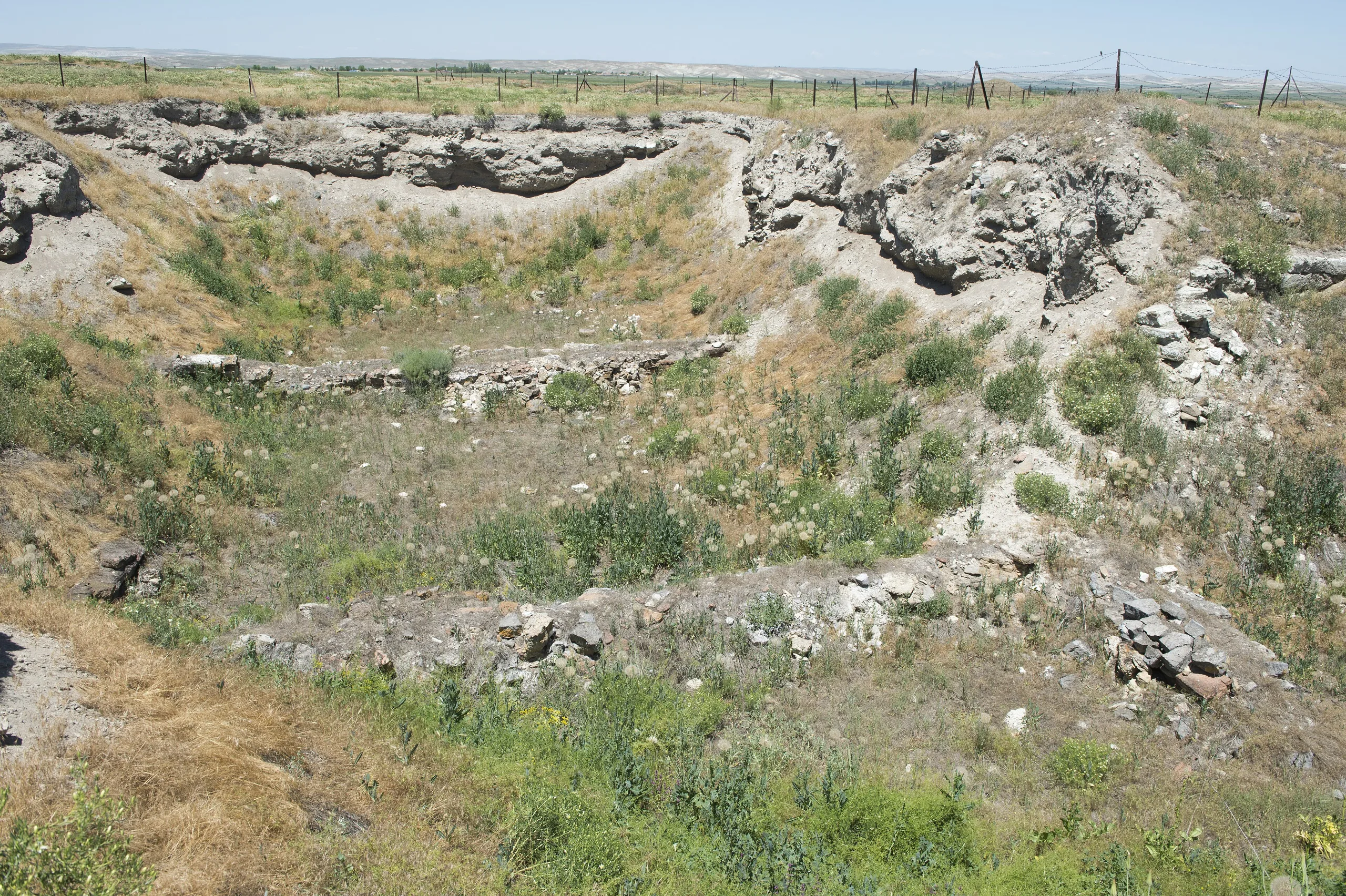
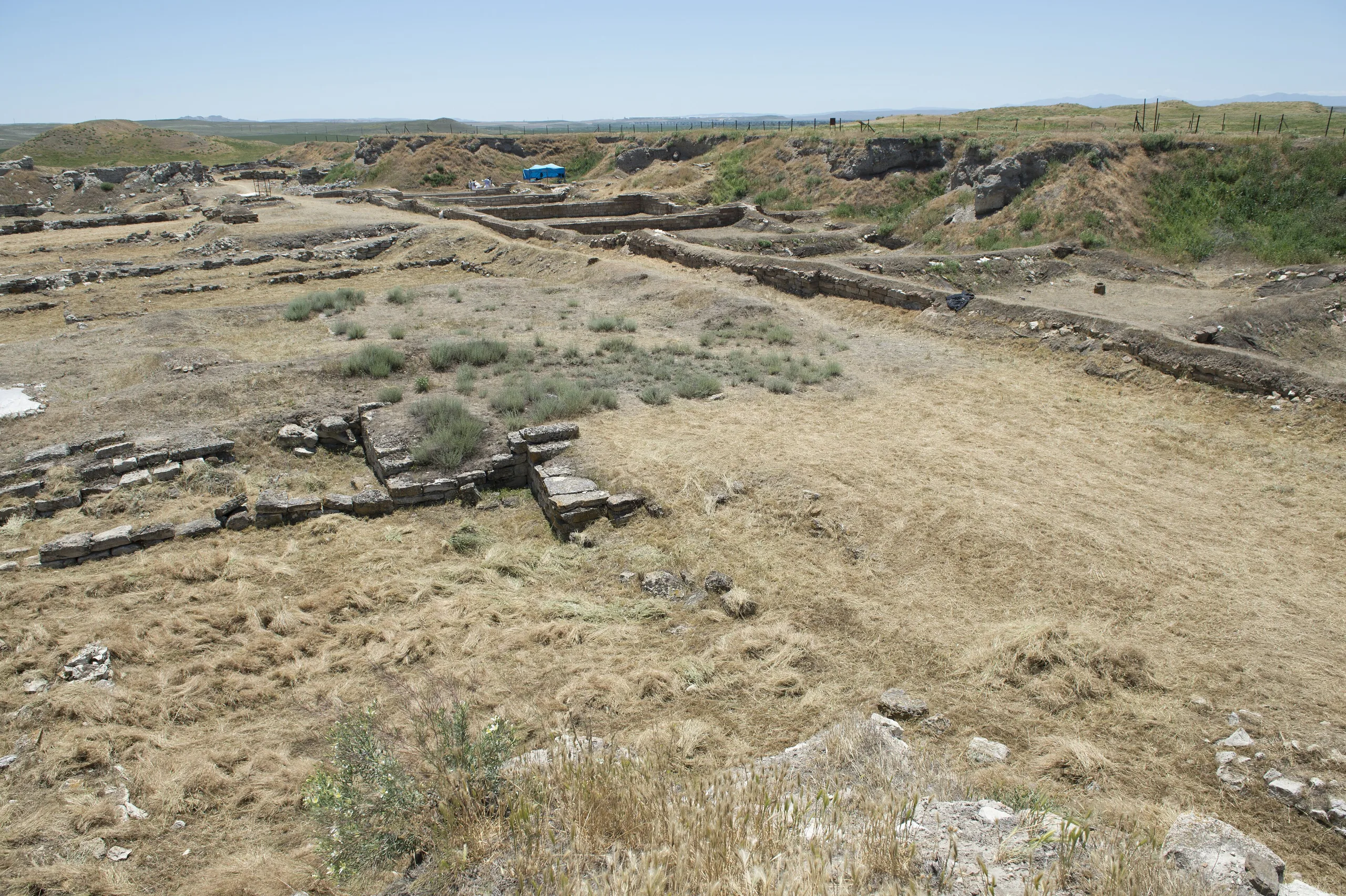
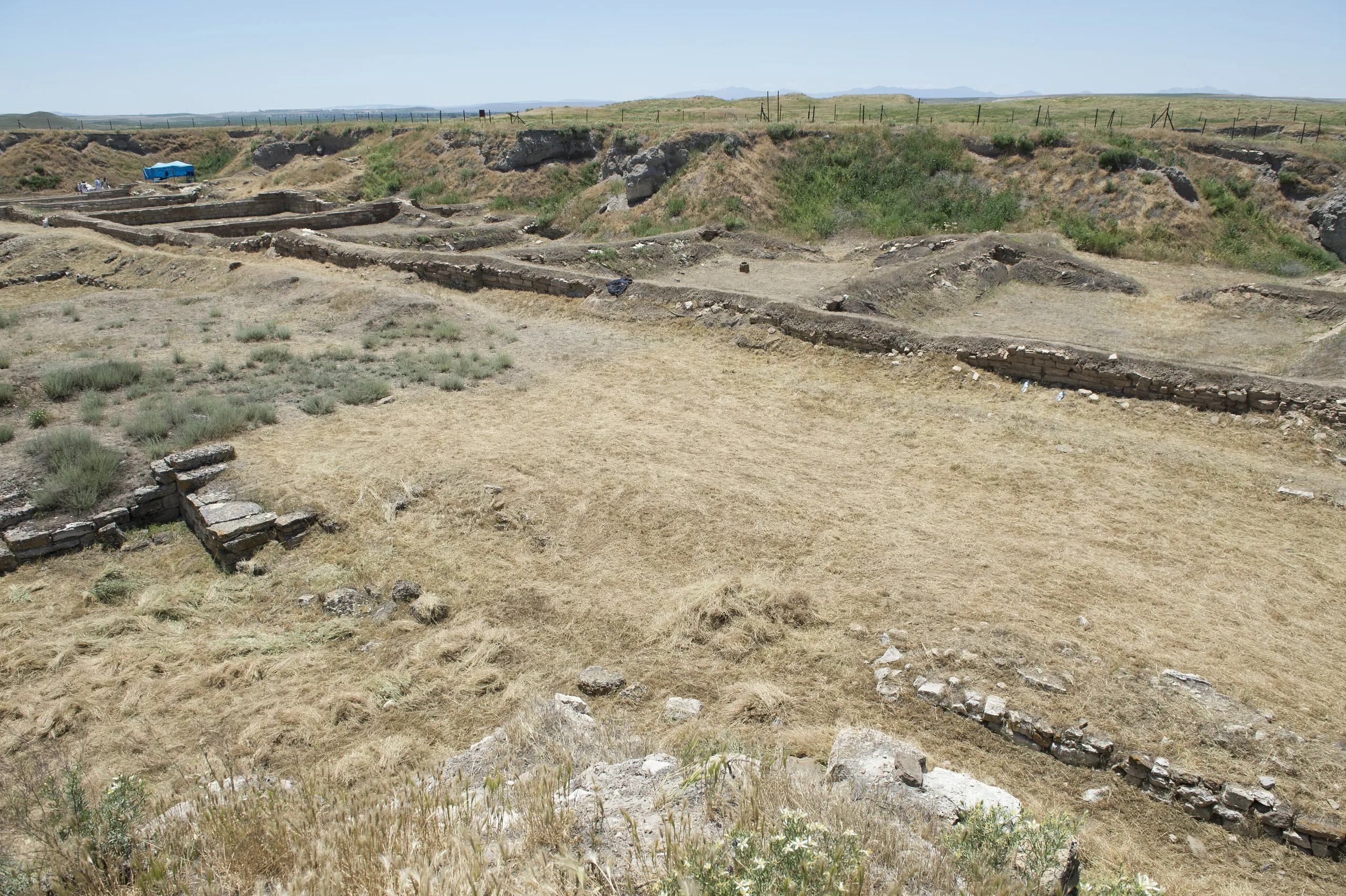
The mound stands 13 to 16 m above the plain and covers about ten hectares, of which only some two have been excavated. On the south-eastern side is a monumental entrance called the East Gate. Its stone walls stand up to ten metres high, and it is the best-preserved fortified gate complex of the Iron Age (10th-8th centuries BCE) found so far. The Palace Area comprises two large courts and megaron-type halls of various sizes; a megaron is a rectangular hall entered through a porch. Next to it, the Terrace Complex, over a hundred metres long, was set aside for large-scale food preparation and textile production, and nothing like it is known from the ancient world. The floors of the elite buildings hold the earliest known coloured mosaics. The central room of the 6th-century Mosaic Building may have been a throne or cult room. The Painted House, built around 500-490 BCE, produced plaster fragments showing women, athletes and birds, and the building is thought to have housed a shrine to the goddess Matar.
The Lower Town
The Lower Town, a residential area of roughly forty-five hectares, was guarded by a large defensive system of two forts and square towers. Life there ended in a fire around 700 BCE, and the ground later became the Common Cemetery, a burial area for people of lower social rank.
The tumuli
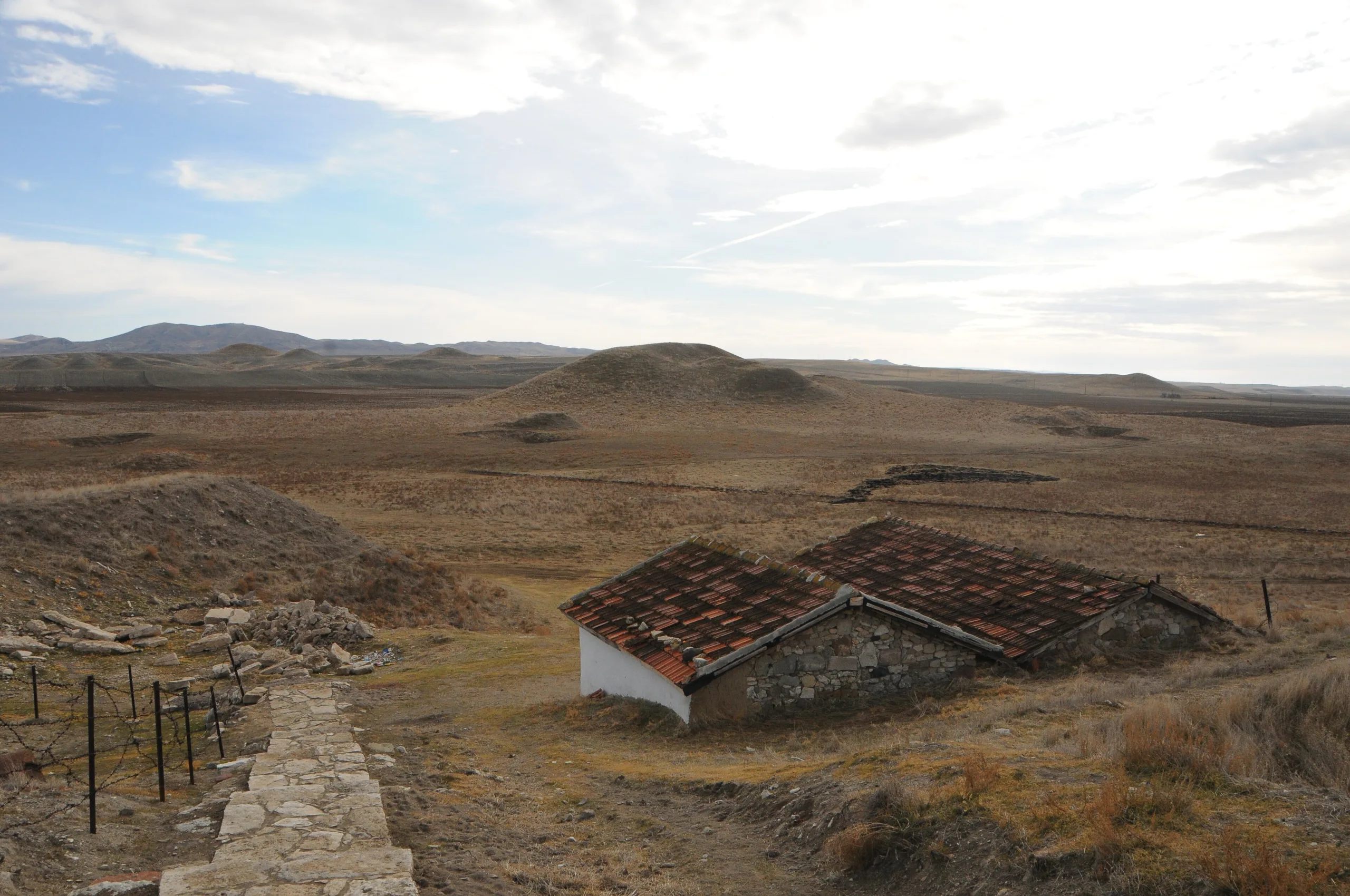
More than a hundred tumuli encircle the Citadel Mound and both lower settlements, the Lower Town and the Outer Town. The burials span the mid-9th century BCE to the late 4th century BCE. The Midas Mound (Tumulus MM) is the second largest tumulus in Türkiye. Its timber chamber measures 5.15 by 6.20 m and is 3.30 m high. Because the date seems too early for Midas, it has been suggested that the tomb belonged to his father Gordios. Rodney Young excavated the mound in 1957, and it opened to visitors in the early 1960s once a concrete support structure was finished. In the museum garden stands Tumulus O, a Galatian tomb found in 1954 during an illegal dig, which was rebuilt there and has been open since 1999.
Excavation and research
Alfred Körte identified the site in 1893, and Alfred and Gustav Körte carried out the first dig in 1900 for the German Archaeological Institute. Work resumed in 1950 under Rodney S. Young of the University of Pennsylvania and went on until 1973. It was interrupted by Young's death in 1974, took up again in 1988 under Mary Voigt and ended in 2005. More than 30 annual campaigns have taken place since 1950. In all, 46 tumuli have been explored: five by the Körte brothers in 1900, 31 by the Pennsylvania team in 1950-1973 and ten by the Museum of Anatolian Civilizations after the 1980s. Since 2011 a long-term conservation programme has been run through the Gordion Archaeological Project, managed by the Penn Museum.
Finds and the museum
Gordion Museum was founded in 1963 beside Yassıhöyük, then a village of 500 people. The display is chronological: three cases hold Early Bronze Age objects, followed by Early Phrygian material ending with King Midas, including handmade Early Iron Age pottery, iron tools and weaving implements. In the new hall a panoramic case presents a typical building from the destruction layer of about 700 BCE. The rest of the hall contains imported Greek pottery, Hellenistic and Roman material dated between the 500s BCE and the 300s CE, plus seals and coins. Fibulae, the decorative pins that fastened clothing, were first used in Anatolia by the Phrygians and served as status items for nobles.
Myth and ancient writers
The episode of the Gordian Knot is told by ancient writers such as Arrian, Quintus Curtius, Justin and Aelian, and Alexander is said to have cut the knot here. Herodotus praises the Phrygians for their fine furniture.
World Heritage and protection
Gordion was inscribed in 2023 (reference 1669) under criterion (iii) alone: the Phrygians excelled in timber building, woodcarving and metalwork, and Gordion, their political and cultural centre, is the best surviving testimony to that civilisation. The nominated area is 1,064 ha with a 4,430 ha buffer zone. The site is protected as a first- and third-degree archaeological conservation area under Ankara Regional Council decision no. 1096 of 16 February 1990. The smallest tumuli suffer from deep ploughing, and measures against looting plus support for the farming community are seen as the key to long-term protection.
Visiting
The museum's address is Yassıhöyük Village, Polatlı. The Müzekart is valid for Turkish citizens. Hours and fees change, so check the museum's official site.
Gallery
Frequently asked questions
Where is Gordion?
Why is Gordion important?
When did Gordion become a World Heritage site?
How big is the Midas Mound?
What is the story of the Gordian Knot?
Who has excavated Gordion?
Sources (16)
- Gordion Örenyeri ve Frig Tümülüsleri / Gordion (TR ve EN sayfaları) — T.C. Kültür ve Turizm Bakanlığı, Müzeler ve Ören Yerleri
- Gordion Museum and Archaeological Site (Bakanlık tanıtım broşürü) — T.C. Kültür ve Turizm Bakanlığı, Kültür Varlıkları ve Müzeler Genel Müdürlüğü
- Gordion (UNESCO Dünya Mirası no. 1669) — UNESCO World Heritage Centre
- Advisory Body Evaluation, Gordion (WHC 1669) — ICOMOS, 2023
- Gordion Nomination for Inclusion in the World Heritage List (Ocak 2021) — T.C. Kültür ve Turizm Bakanlığı / UNESCO Dünya Mirası Merkezi
- Gordion (Digital Gordion, hakkında) — Penn Museum, Gordion Archaeological Project
- Gordion/Vindia? (Pleiades place 609393) — Pleiades
Photo credits
- Photo: Volker Höhfeld, CC BY-SA 4.0 — Wikimedia Commons (resized)
- Photo: Stipich Béla, CC BY 2.5 — Wikimedia Commons (resized)
- Photo: Özge Kesgin, CC BY-SA 4.0 — Wikimedia Commons (resized)
- Photo: Özge Kesgin, CC BY-SA 4.0 — Wikimedia Commons (resized)
- Photo: Gargarapalvin, CC BY 4.0 — Wikimedia Commons (resized)
- Photo: Gargarapalvin, CC BY 4.0 — Wikimedia Commons (resized)
- Photo: Dosseman, CC BY-SA 4.0 — Wikimedia Commons (resized)
- Photo: Dosseman, CC BY-SA 4.0 — Wikimedia Commons (resized)
- Photo: Dosseman, CC BY-SA 4.0 — Wikimedia Commons (resized)