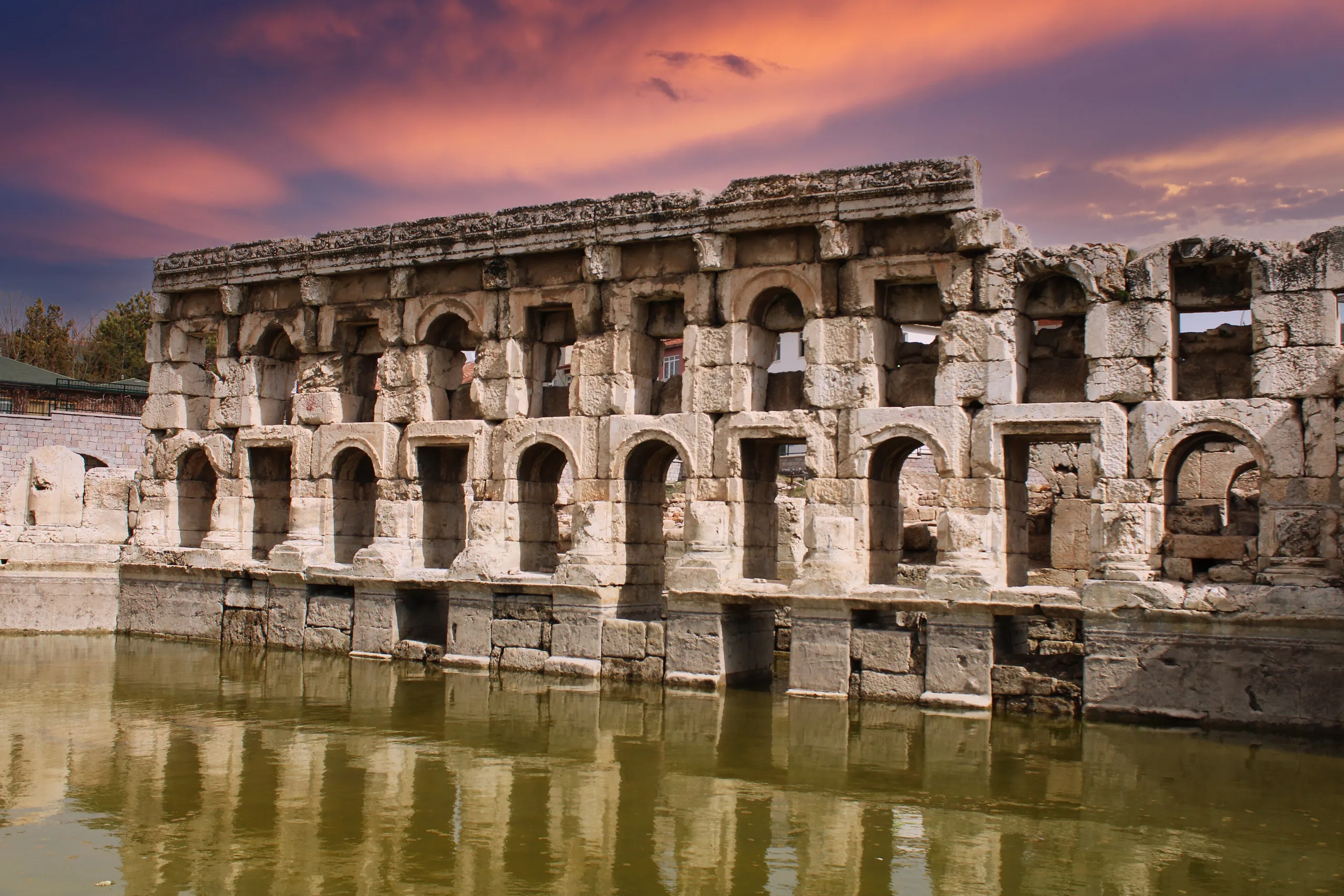
A Roman bathhouse in Sarıkaya, Yozgat, built directly over a hot spring; its 30 m marble facade and big open pool make it one of Anatolia’s few surviving Roman thermal baths.
Sarıkaya Roman Baths is a place (Hammam) in Turkey, Yozgat. Main periods: Roman Period, Byzantine Period, Seljuk Period, Ottoman Period.
In the middle of Sarıkaya, a marble facade some 30 metres long rises in arches beside a wide pool fed by hot water welling up through its floor. The Romans knew the settlement as Aquae Sarvenae, the Waters of Sarvenae. When a church was added next to the baths in Byzantine times, the town became Therma Basilica. Few Roman thermal buildings in Anatolia survive in anything like this form, and the Sarıkaya baths are among them.
History
Sarıkaya sits some 77 km southeast of Yozgat, along the road that links the Black Sea with the Mediterranean, in a broad valley 1,170 m above sea level. The town sits here because of the spring, which has run since antiquity. The baths were built at the lowest point of the valley, right over the place where the water comes out. Their decoration and the finds from them point to construction in the middle of the 2nd century AD.
As Christianity spread through the region a church was attached to the north side, which explains the Byzantine name. The settlement was a bishopric until AD 451 and was ringed by a wall roughly three kilometres long. Christian tradition has Saint Peter travelling from Sivas to Kayseri and then on to Tavium, with a stop at Therma Basilica along the way. After the battle of Manzikert in 1071 the area slid gradually under Turkish rule; the Danishmends, Seljuks, Mongols, Eretnids, Kadı Burhaneddin and Dulkadirids followed, and Ottoman administration began in 1521. Through all of this the baths stayed in use, picking up alterations and additions.
In Ottoman times the settlement was called Ilısu, warm water. In the empire’s last years it was Hamam Köyü, Bath Village, and early in the Republic it appears as Terzili Hamamı. Spring revenue mattered so much that in 1905 teachers’ salaries in Boğazlıyan were paid from it. Infrastructure works of the Republican era later did serious damage to the building.
What survives
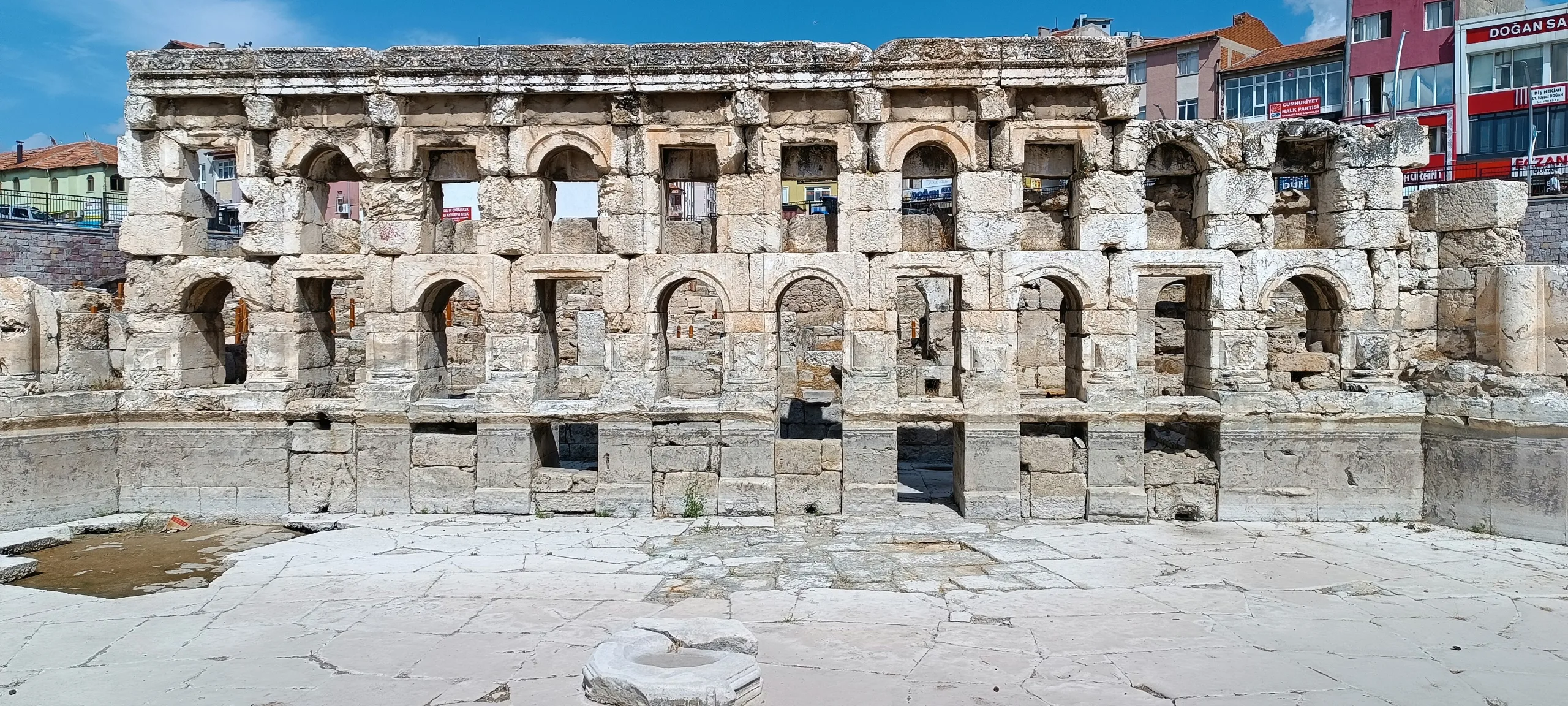
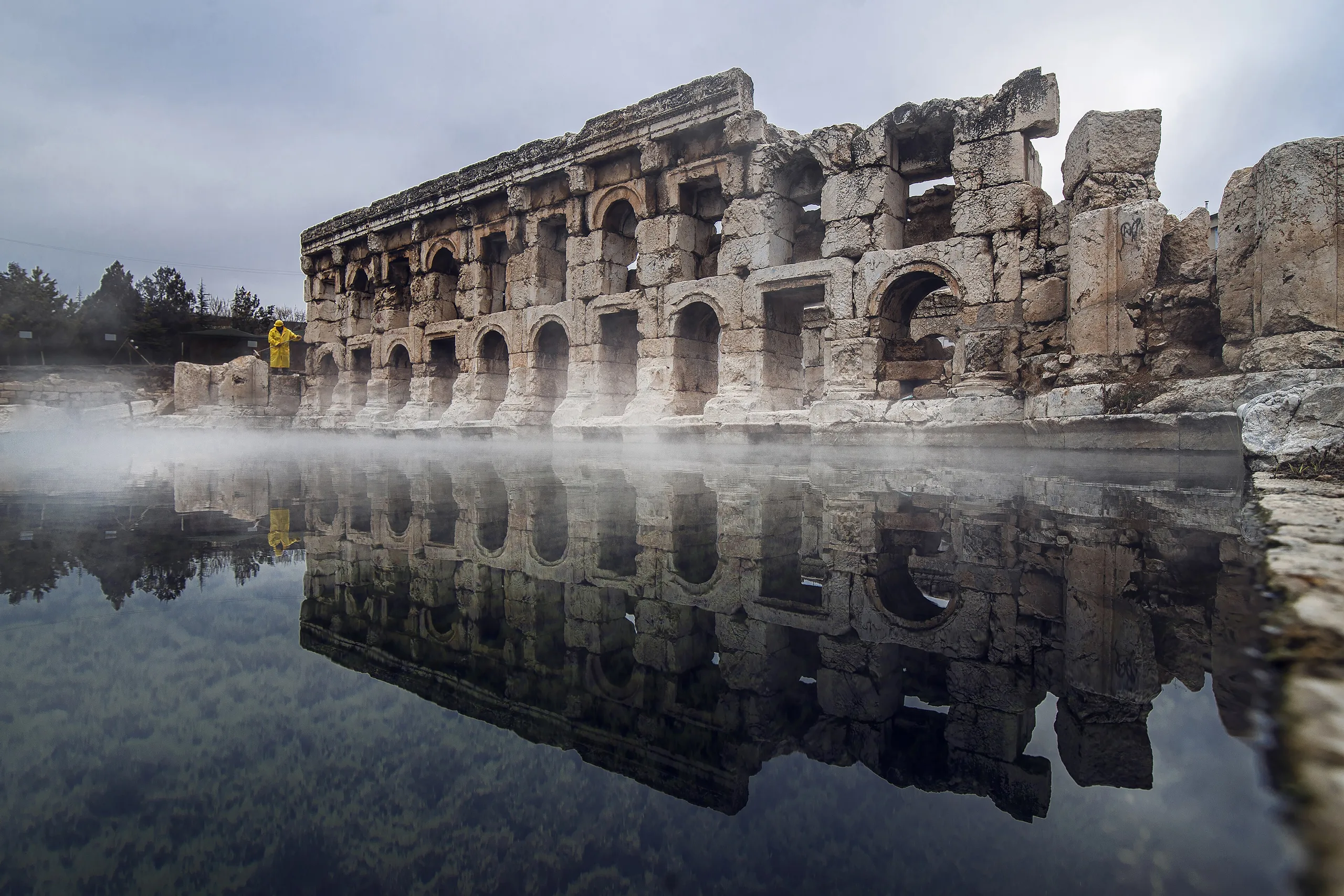
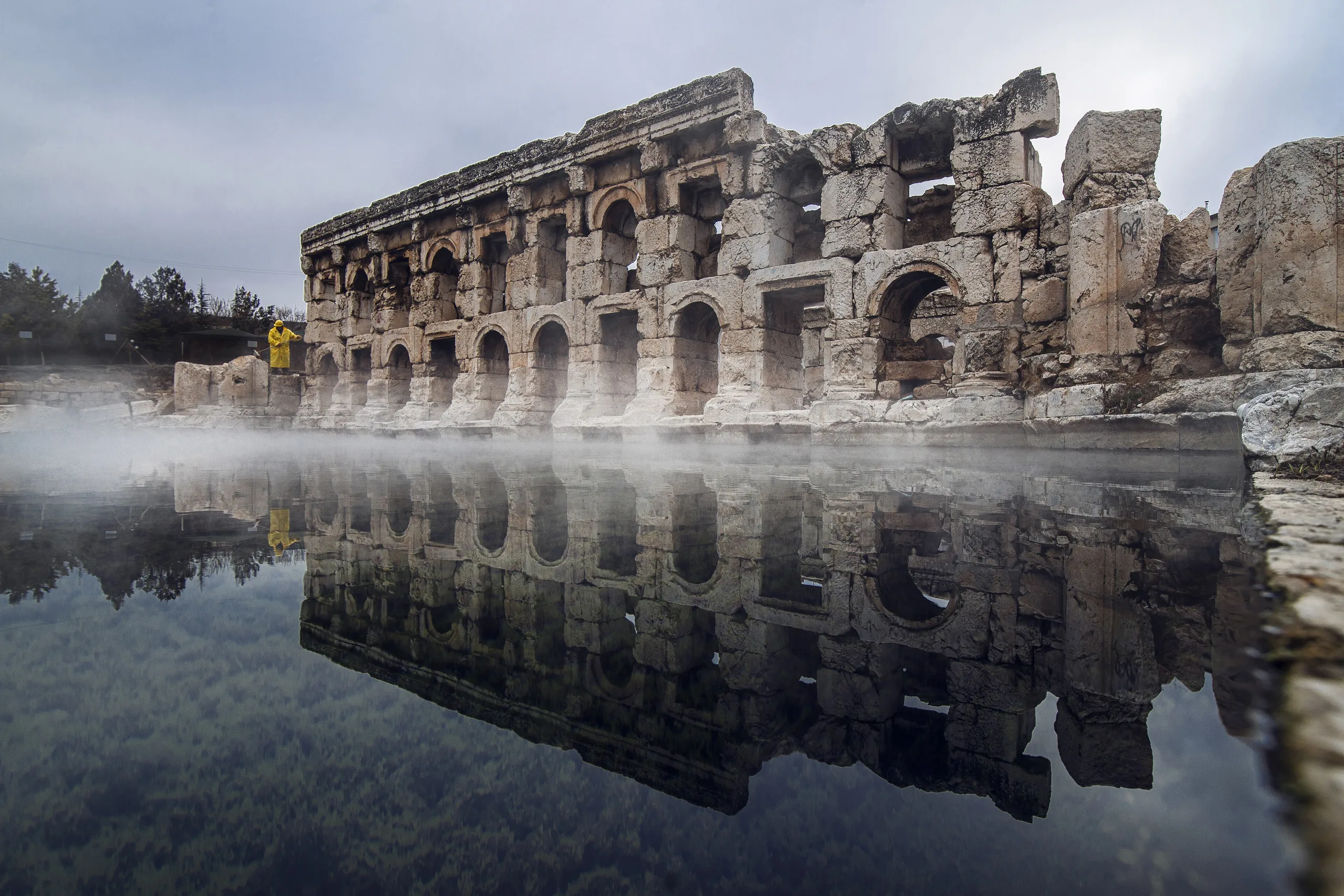
The ornate facade faces west and runs north to south. It is about 30 m long and 4.5 m high, built of local marble. A small semicircular pool sits at each end; the northern one has a marble floor, while the southern one has not yet been cleared down to its base. The facade follows the Corinthian order, the style of columns topped with acanthus-leaf capitals. Its two rows of arches are laid out in opposite directions, and the upper zone carries egg-and-dart mouldings and a frieze of bulls’ heads joined by garlands. A snake-like figure on the facade may stand for Asclepius, the god of healing, which would suggest that people came here for cures as well as for washing.
The large pool in front of the facade measures about 23.30 by 12.80 m and is 1.34 m deep, with a marble floor that is distorted in places. In its middle stands a two-part baptismal stone with a cross carved in relief inside a concave circle, evidence that the pool took on a sacred role in the Eastern Roman period. Behind the facade is an inner pool of 16 by 4 m with a staircase on each side, and beside it a third hot pool of about 15 by 5.20 m. East of the southern semicircular pool, excavators found a room with a destroyed floor, where only roughly cut stone supports remain; it was heated from below.
The structure rests not on firm ground but on a soft area where water rises from every side, and it has still lasted close to two thousand years. This is taken as a measure of how well Roman builders could found heavy masonry on weak soil.
Research and protection
The French traveller Chantre drew the facade in 1893-1894, which brought the baths into the scholarly literature. The first measured survey came in 1932, when Richard C. Haines, working with the Chicago University team that excavated Alişar, recorded the facade and drew a plan. Yozgat Museum carried out excavations for the Ministry in 2010-2015: three modern public buildings and three expropriated houses were demolished, and the thermal pools were exposed in 2014. The monument has been protected since 1987, and in 2013 it was upgraded, together with its surroundings, to archaeological site status. It entered UNESCO’s Tentative List in 2018 under criterion (iv); it is described as the only protected Roman thermal bath in Anatolia.
Visiting
Conditions and hours can change, so check the page for the site on muze.gov.tr. The baths are in the Kaplıca district of Sarıkaya town centre, where the spring water is still in use today.
Gallery
Frequently asked questions
Where are the Sarıkaya Roman Baths?
When were the baths built?
Why is the town called Therma Basilica?
What is the carved stone in the pool?
Is it a World Heritage Site?
Where do I find visiting times?
Sources (7)
- Sarıkaya Roma Hamamı / Sarıkaya Roman Baths (TR ve EN sayfalar) — T.C. Kültür ve Turizm Bakanlığı, Müzeler ve Ören Yerleri
- Basilica Therma (Sarıkaya Roman Bath) - Tentative Lists, ref. 6350 — UNESCO World Heritage Centre
- Basilica Therma (Wikidata Q54811523) — Wikidata
Photo credits
- Photo: Leonphotograpy, CC BY 4.0 — Wikimedia Commons (resized)
- Photo: Seraksin, CC BY-SA 4.0 — Wikimedia Commons (resized)
- Photo: Volcanicaaa, CC BY-SA 4.0 — Wikimedia Commons (resized)
- Photo: Volcanicaa, CC BY-SA 4.0 — Wikimedia Commons (resized)