The Lydian capital near Manisa where coinage was invented: the Temple of Artemis, the biggest synagogue of the ancient world and the huge Bin Tepe tumuli. World Heritage since 2025.
Sardis is an ancient city located in Turkey, Manisa. Main periods: Archaic Period, Hellenistic Period, Roman Period, Byzantine Period, Iron Age. It was inscribed on the UNESCO World Heritage List in 2025.
The Tumulus of Alyattes is 355 m across and 63 m high, and Herodotus ranked the tomb second only to the monuments of Egypt and Babylon. It stands at Bin Tepe, 7 to 17 km north of Sardis, and still speaks of the wealth a Lydian capital could command. Sardis (Turkish Sardes) lies in the Salihli district of Manisa, at the edge of the Gediz (Hermos) plain under Bozdağ (Mount Tmolus), on the bank of the Sart stream, the ancient Pactolus, which carried gold dust. Legend gives its foundation to a king called Meles. As the only city of the Lydians and the place where coinage is said to have been invented, it joined the UNESCO World Heritage List in 2025 together with the Bin Tepe tumuli.
Setting
The ancient city lies about 62 km east of Manisa, inside Salihli, and the İzmir-Ankara road runs through the Sart neighbourhood. The Bin Tepe tumulus field begins 7 km north of the acropolis and stretches to 17 km. For hours, fees and visiting conditions see the official museum page. The Müzekart is valid for Turkish citizens.
From the Lydians to Byzantium
Between the 8th and 6th centuries BC the Lydians rose, conquered most of western Anatolia and built the region's first empire. They invented coinage, and their neighbours soon copied it. A dynasty running from Gyges to Croesus signed treaties with Mesopotamia, Egypt and Greece and dedicated gold at Greek shrines such as Ephesus, Didyma and Delphi. Croesus reigned from 580 to 547 BC, when Cyrus of Persia defeated him. The fall became a lesson on the punishment of pride, retold from Herodotus onwards.
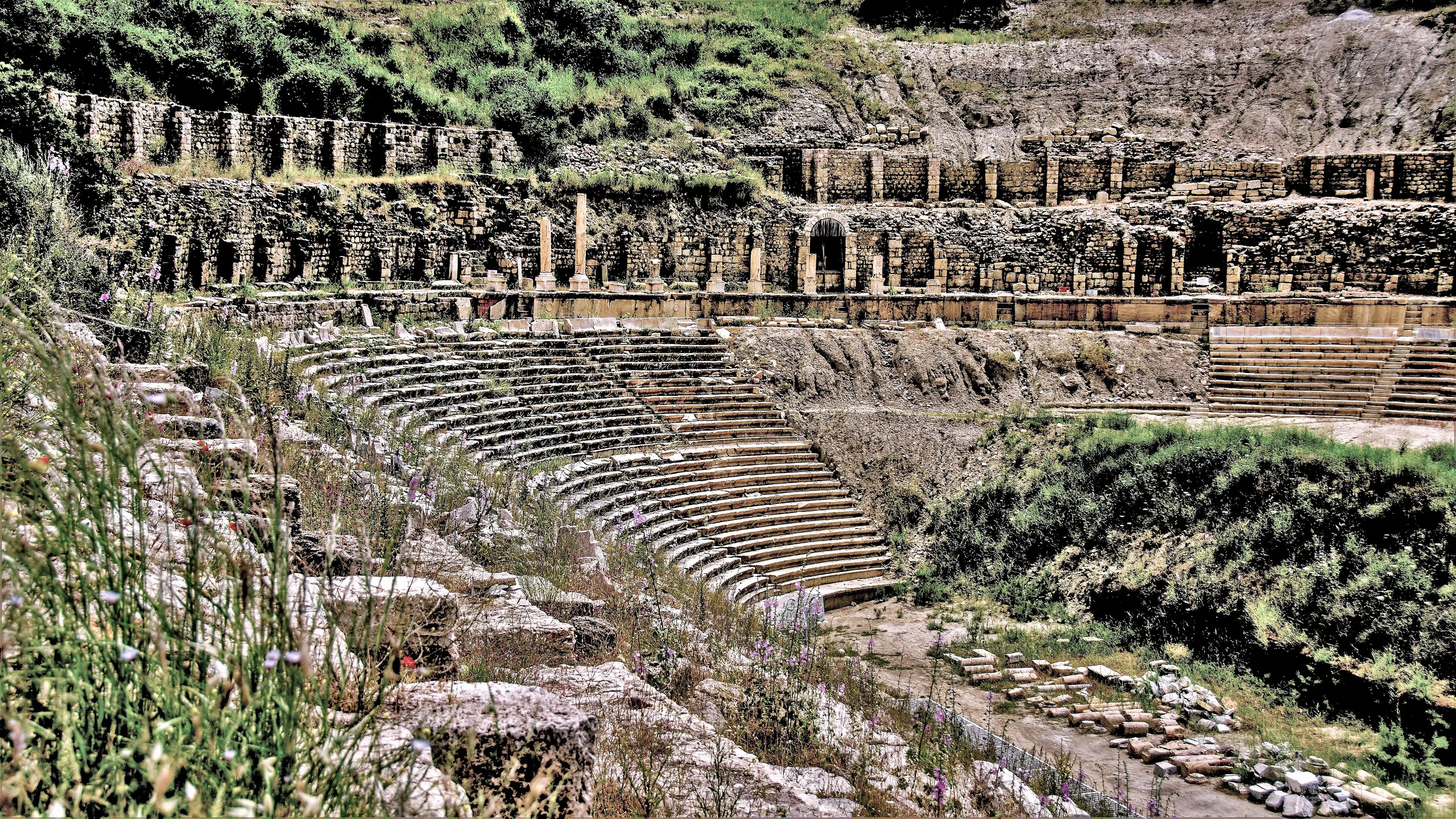
Under Persian rule Sardis was the seat of a major satrapy. Alexander the Great took the city without a fight in 334 BC. Through the Hellenistic age it slowly changed from a Persian provincial capital into a Greek polis, and the Seleucid dynasty made it their main seat in the west. A city council, a treasury, a new mint, a temple of Artemis, a theatre, a gymnasium and a hippodrome were added in this time, along with other Greek institutions and building types. In 188 BC control passed from the Seleucids to neighbouring Pergamon.
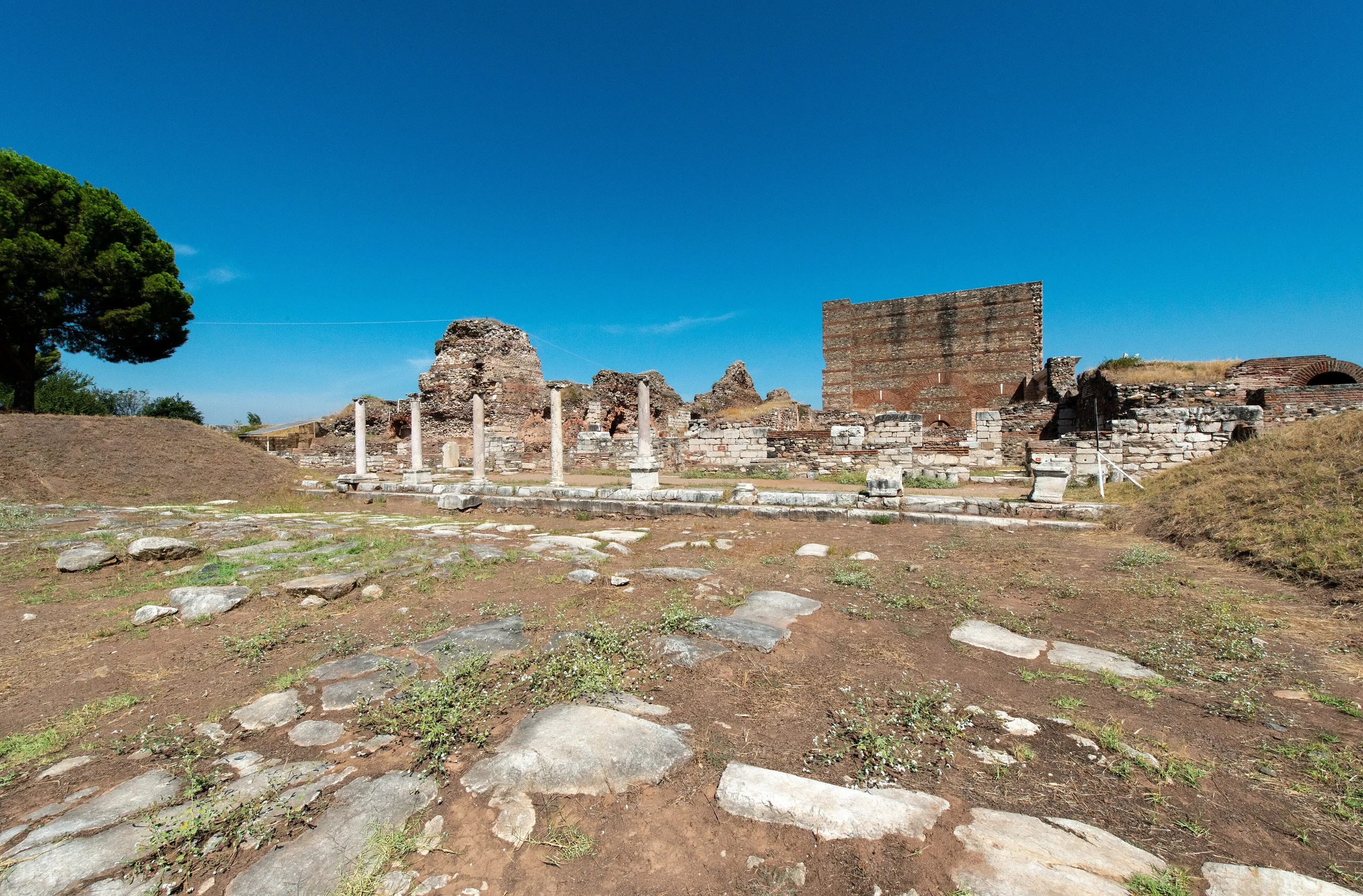
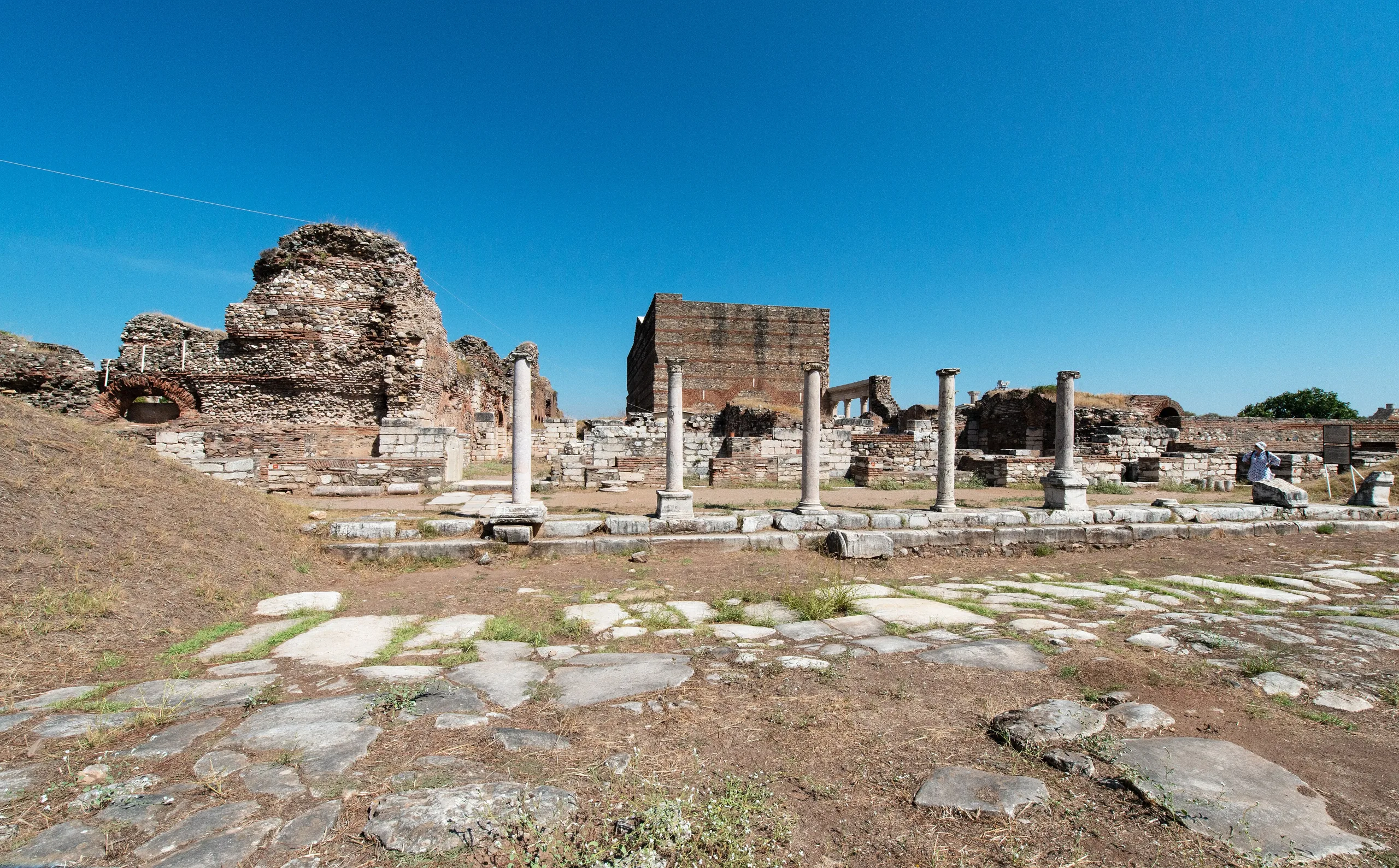
The Roman peace brought prosperity; excavations have revealed an imperial cult temple, big baths, a stadium, aqueducts and other civic buildings. Sardis is one of the Seven Churches of the Book of Revelation, though no church of that age has turned up. After Diocletian reorganised the empire it became capital of the province of Lydia and flourished in the 4th and 5th centuries AD, and under Byzantine rule it was an important bishopric. The lower city declined in the 6th and early 7th centuries and was largely empty by the 7th, while the acropolis lived on as a fortress.
What can be seen
The Lydian city and its walls
The Lydians organised their capital as a series of monumental terraces, a design unlike the town plans of Greeks, Egyptians or Near Eastern peoples. A wall about 3.5 km long and 10 to 20 m thick protected the lower city, one of the largest ancient fortifications in Anatolia. Lydian houses were of mud brick, rock-cut tombs lie along both banks of the Pactolus, and a Lydian gold-refining workshop has been found. Most of the Lydian remains in the city core lie deep beneath later Hellenistic, Roman and Byzantine buildings.
Temple of Artemis
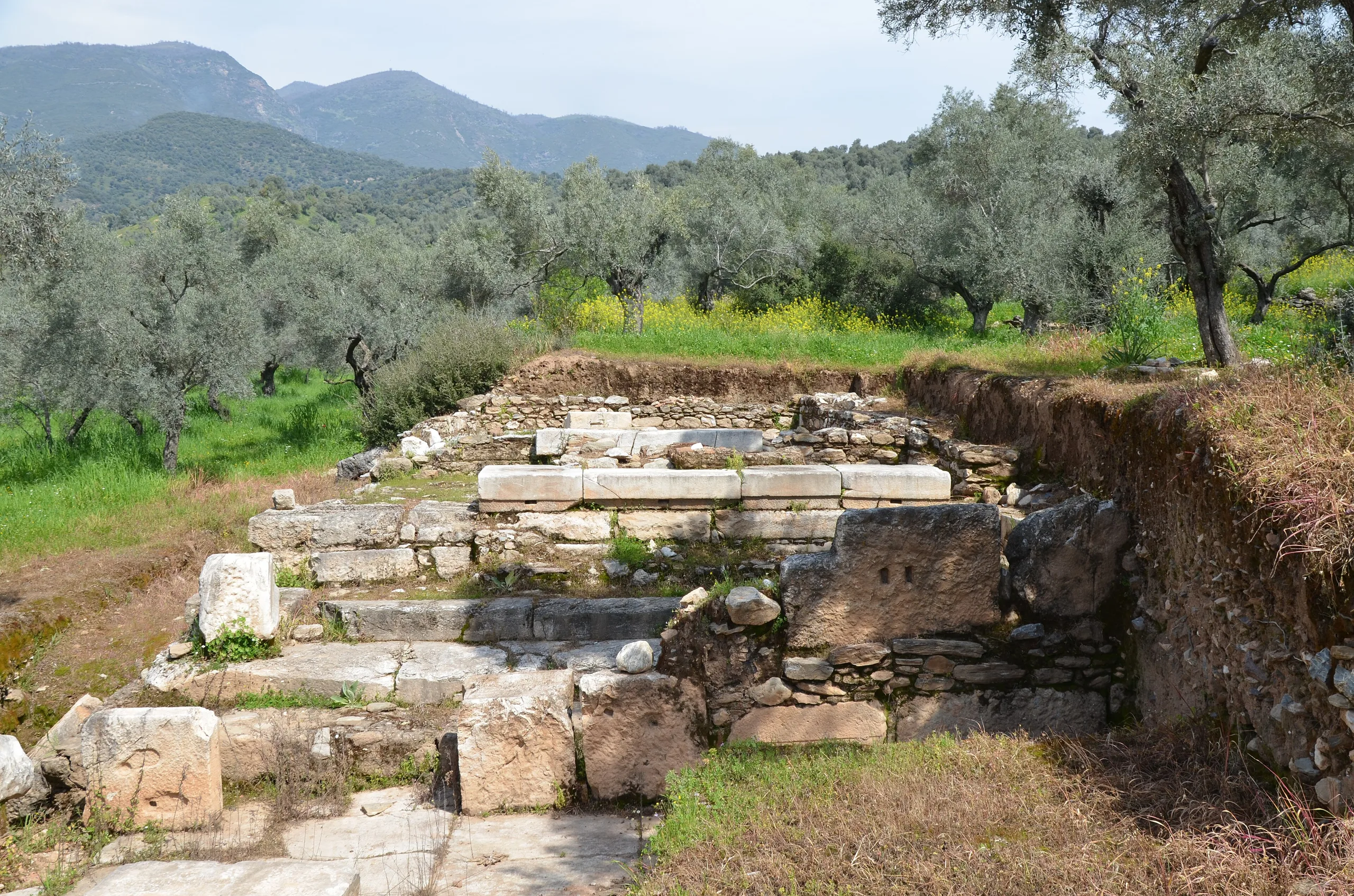
Building began in the Hellenistic period, most likely over an older shrine of Cybele. The temple is Ionic and pseudo-dipteral, meaning it gives the look of a double row of columns while leaving the inner row out. It was first dedicated to Artemis. Later the cella was divided into four compartments, and heads of Artemis, Zeus Polieus, Emperor Antoninus Pius and his wife Faustina were found in them. The earthquake of AD 17 brought the temple down and Tiberius had it rebuilt to the old plan. In the 4th century a small chapel (Church M) was added at the south-east corner. Among Ionic temples anywhere, only three are bigger.
Bath-gymnasium complex and synagogue
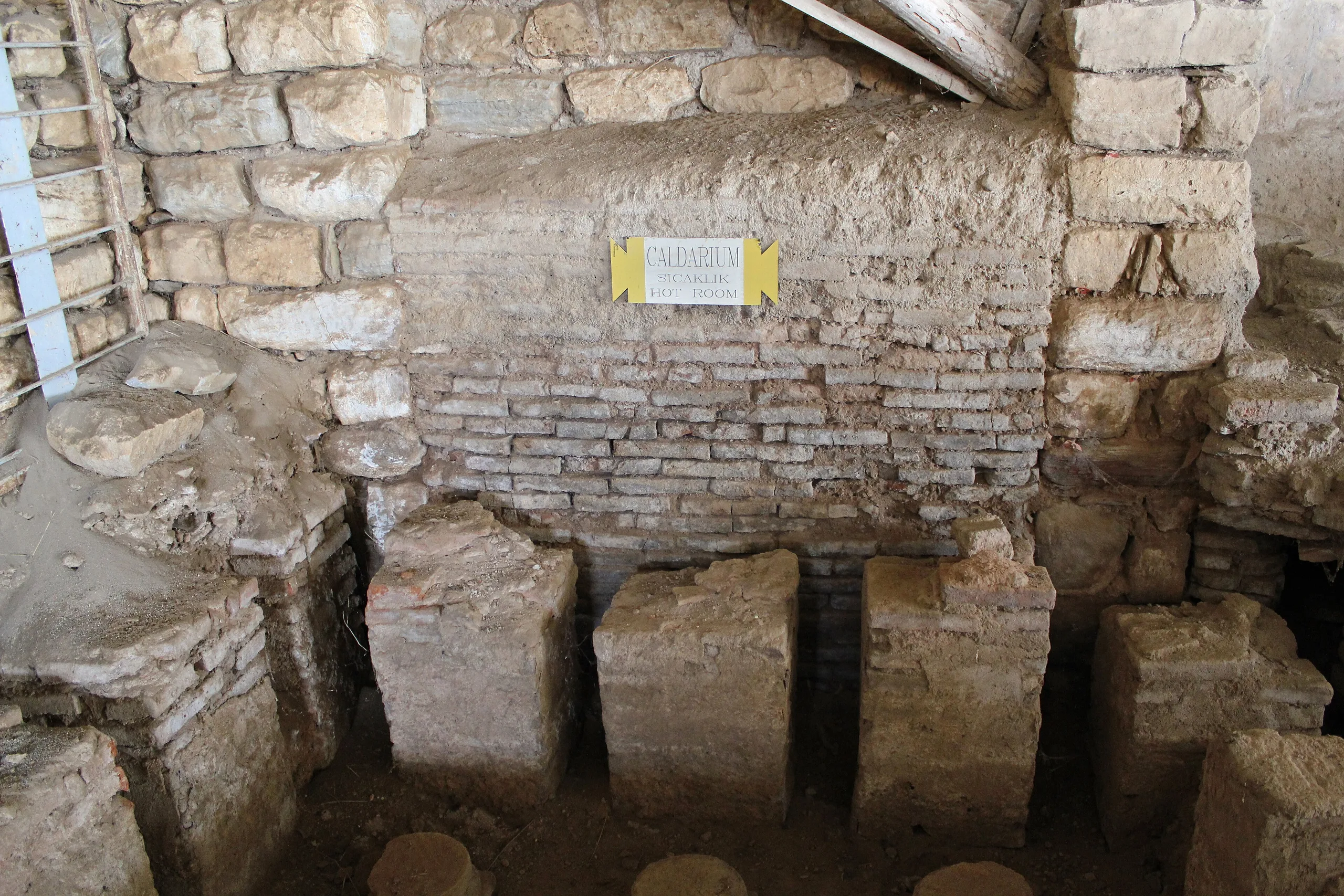
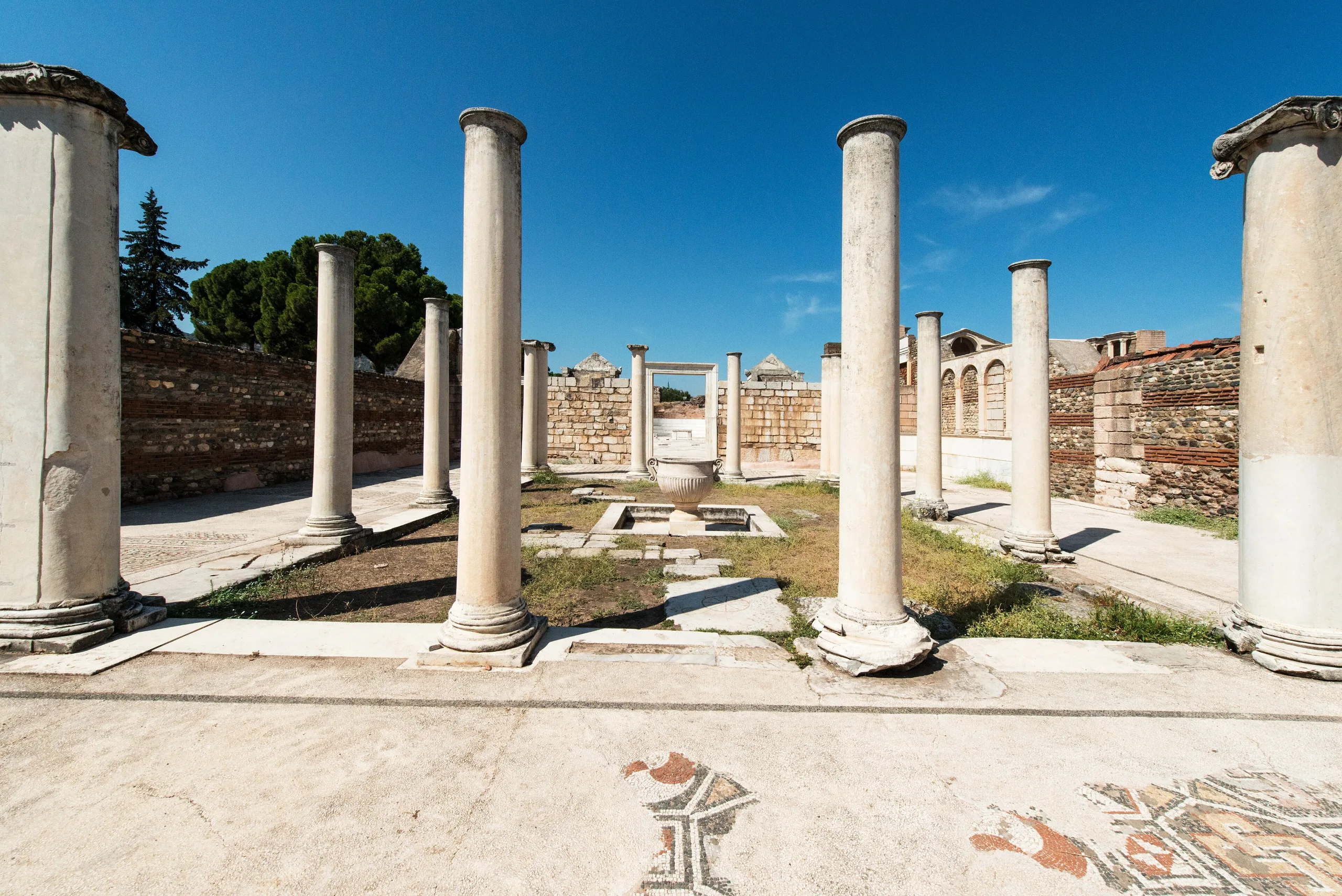
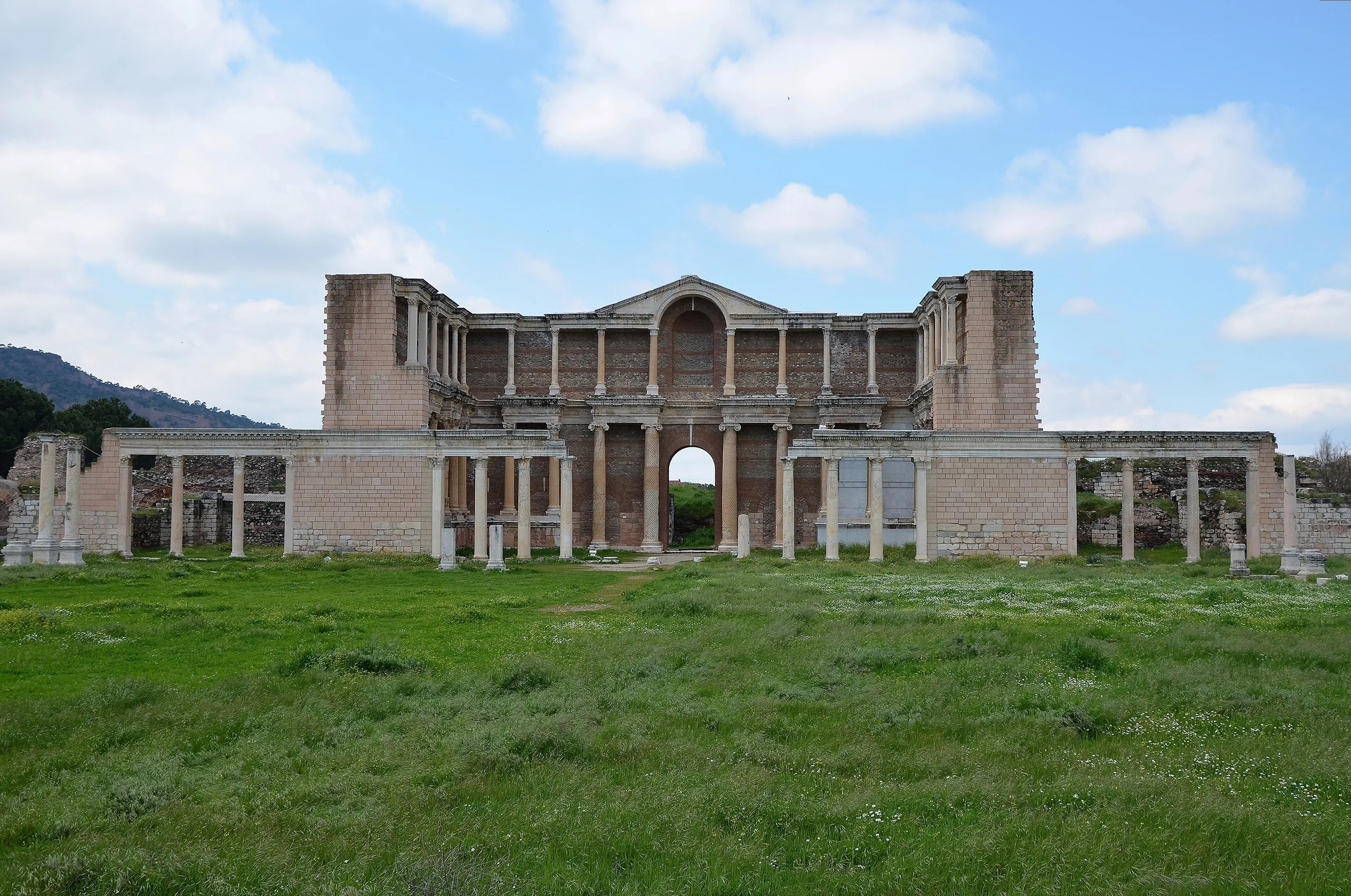
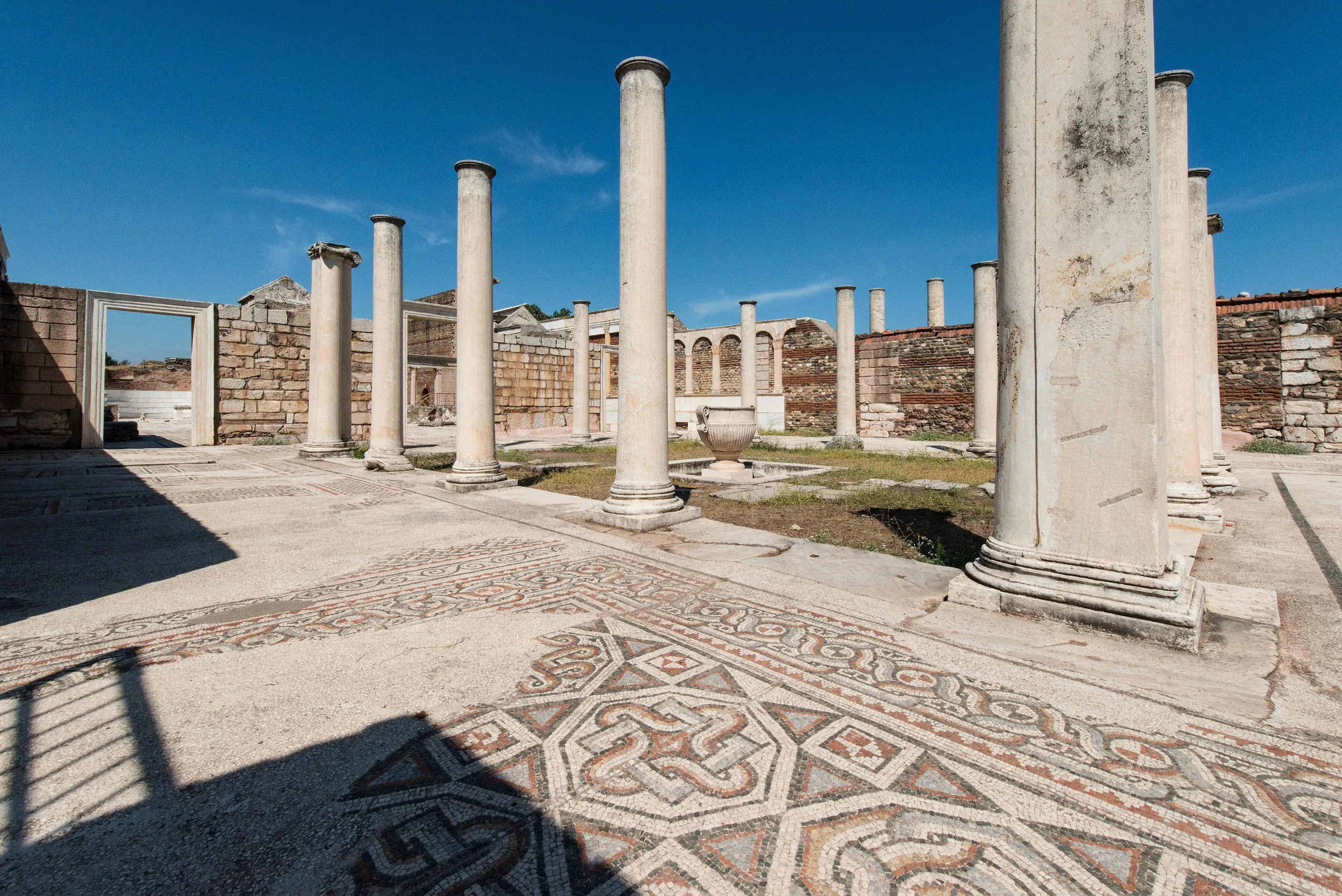
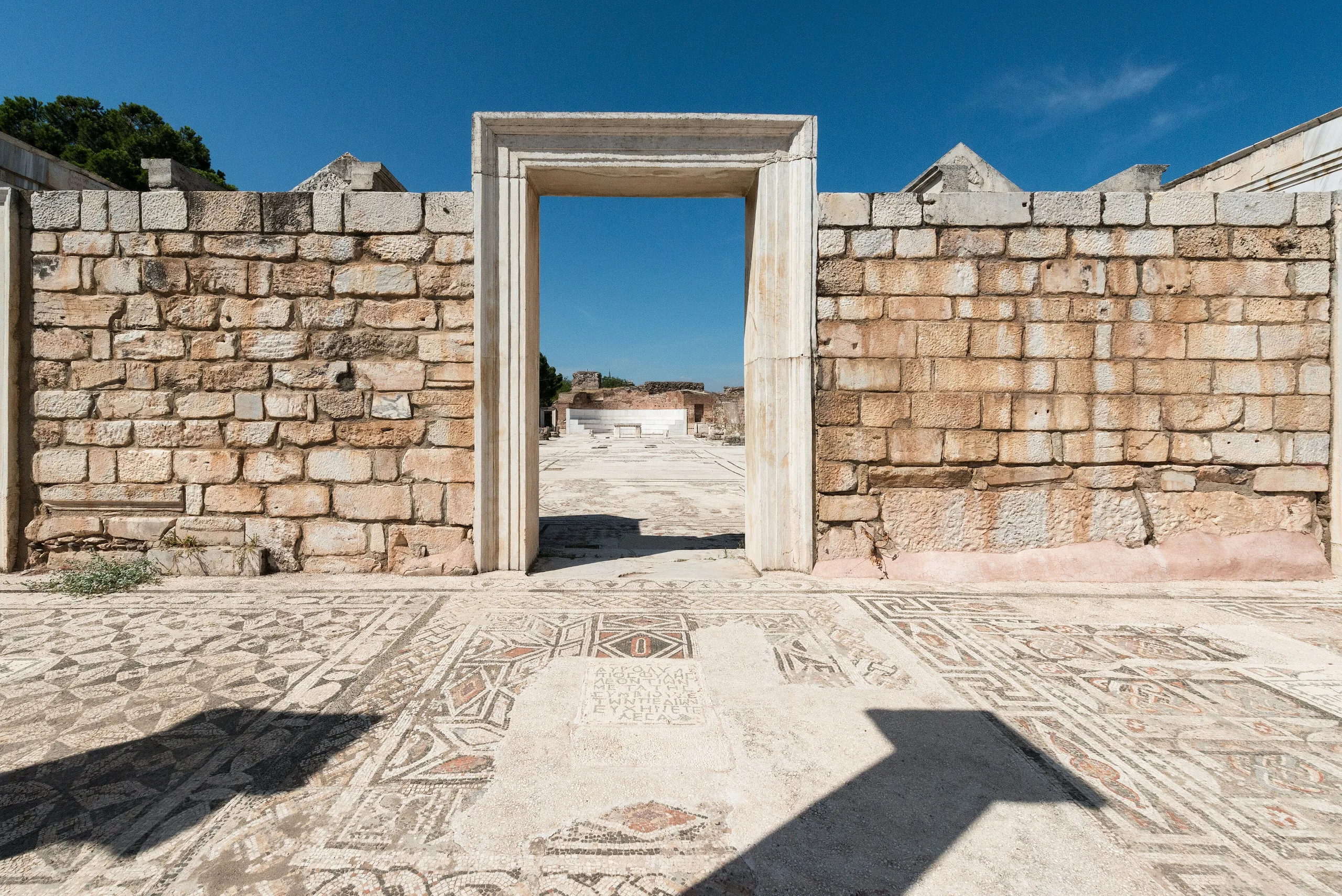
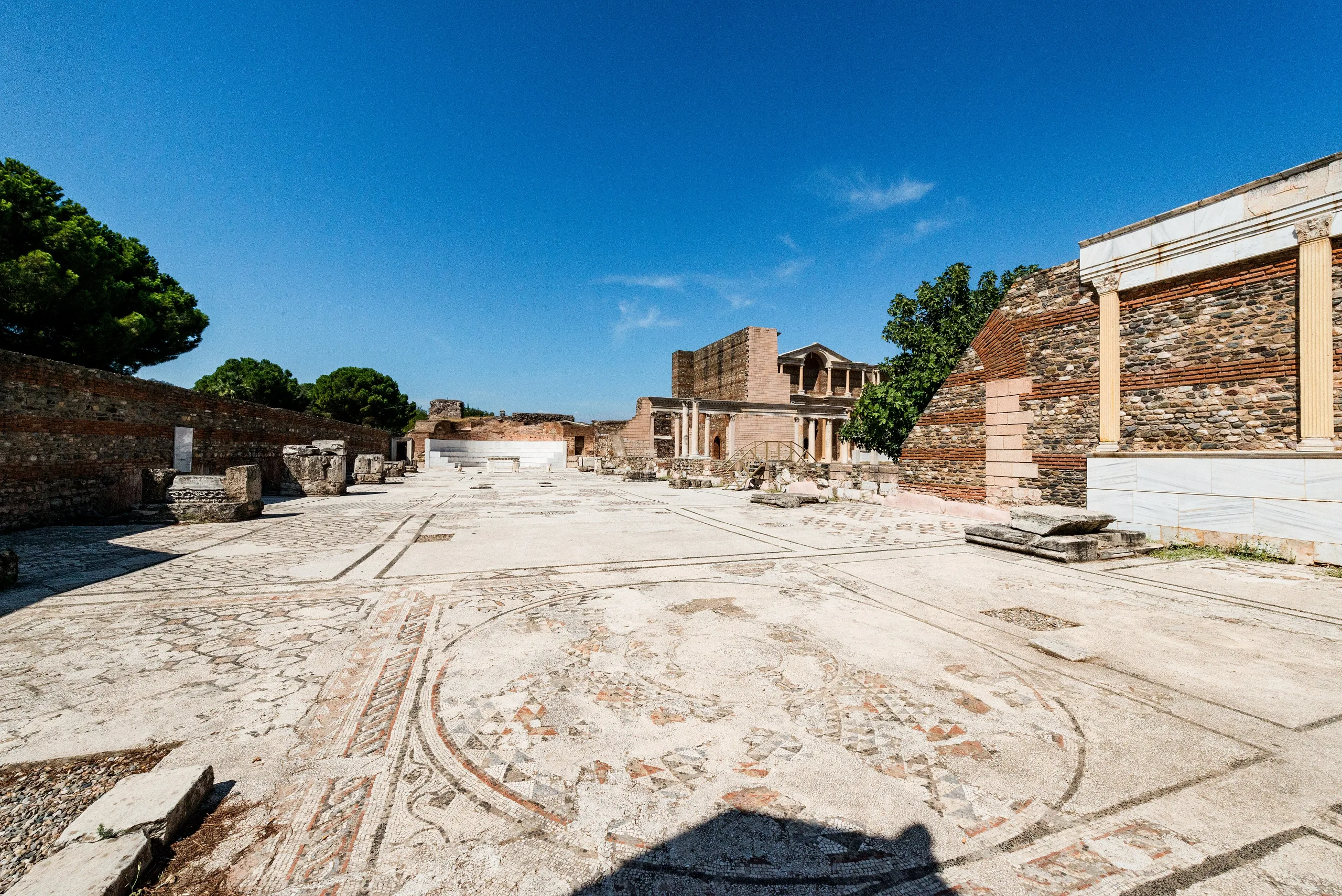
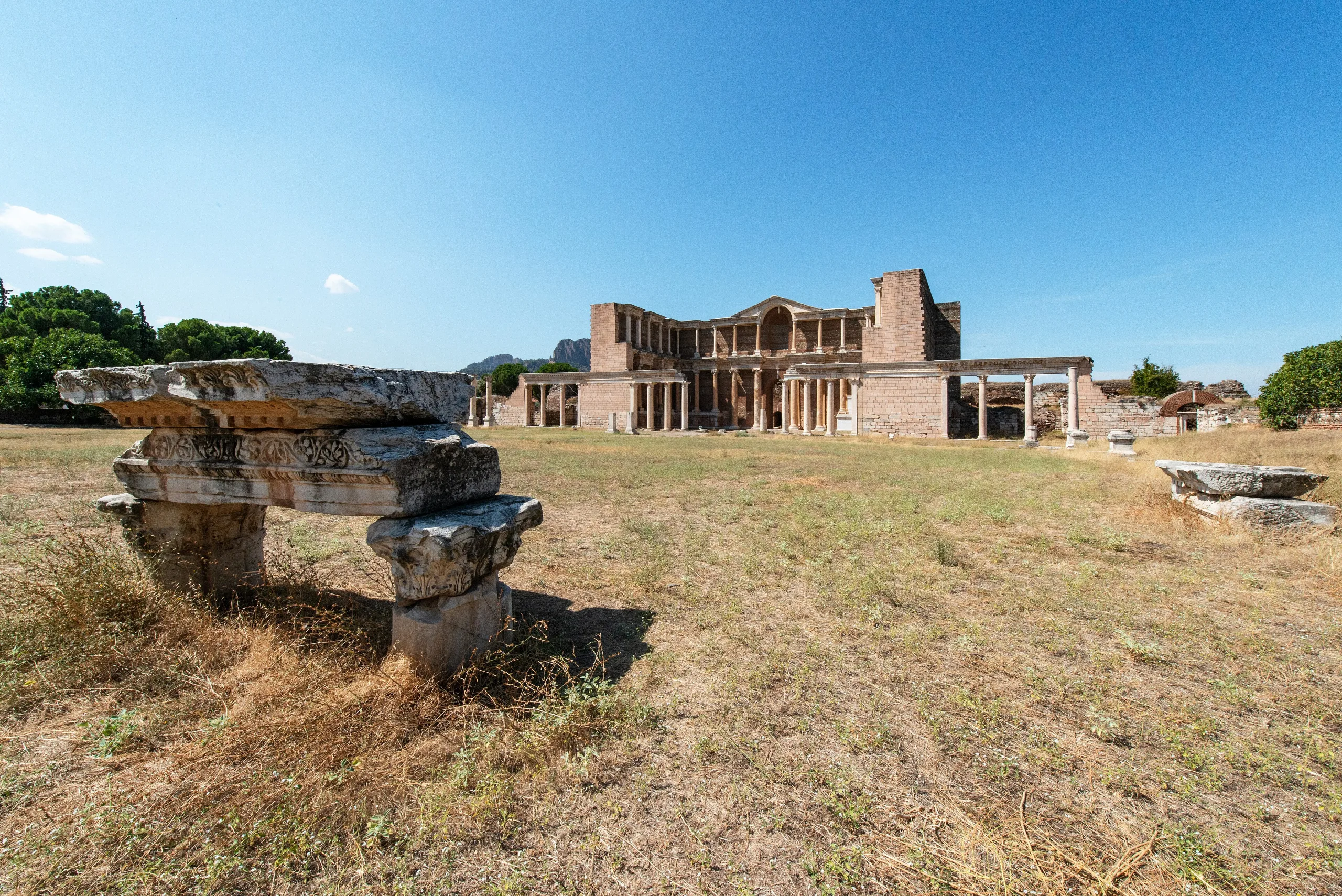
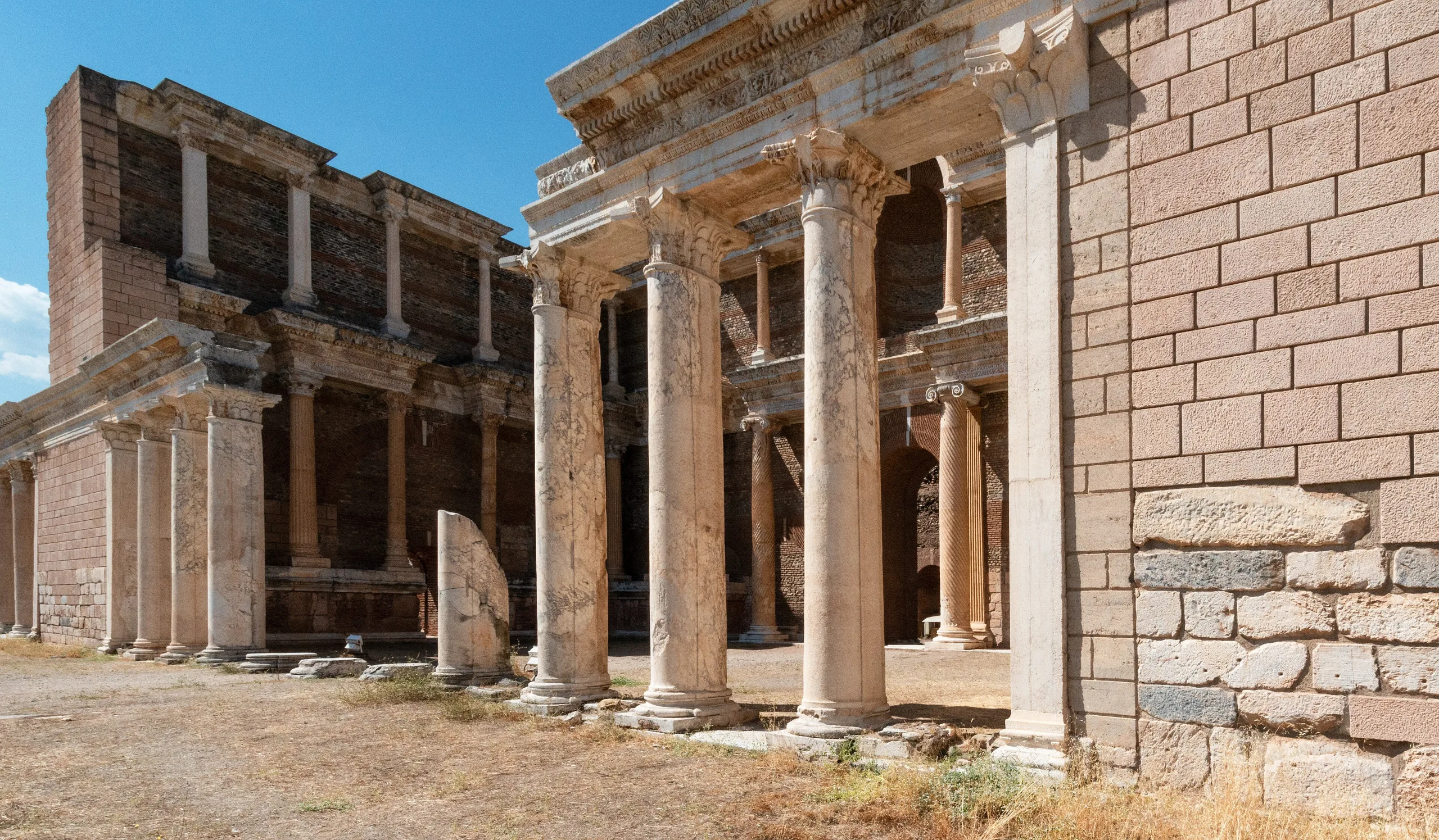
A square court ringed by columns, the palaestra, fills the east half of the complex and was meant for sport, while vaulted halls to the west were baths. A two-storey colonnaded passage is known as the Marble Court. The basilica-shaped hall south of the palaestra was converted to a synagogue during the 3rd century AD, and it is the largest and most richly decorated synagogue known from antiquity. The complex was excavated between 1958 and 1973, and the Marble Court and synagogue were restored in 1965-1973. The Marble Court had collapsed in an earthquake in the early 7th century.
Bin Tepe tumuli
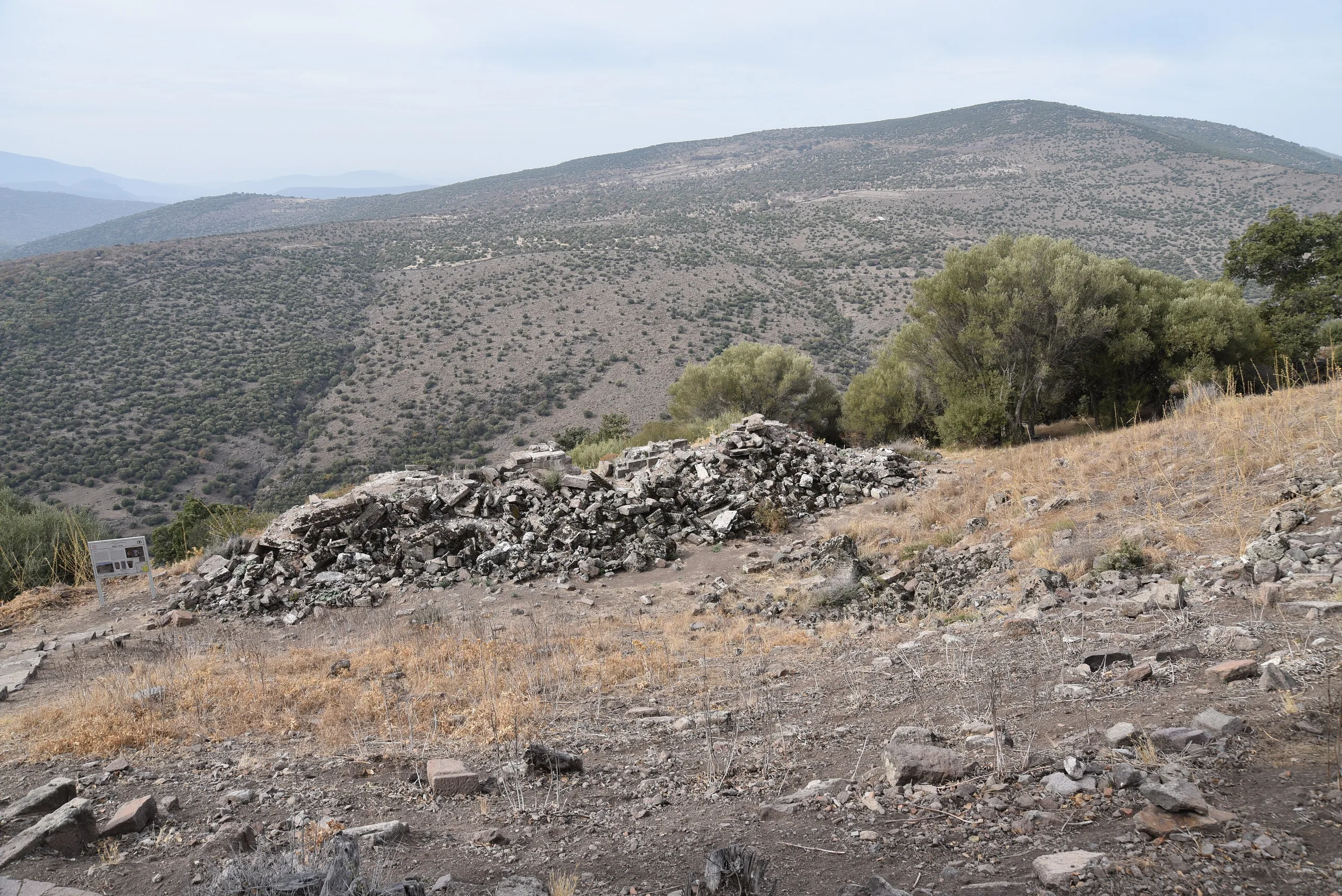
Bin Tepe is the biggest tumulus cemetery in Turkey; a tumulus is an artificial mound heaped over a grave. More than 119 mounds have been counted, and about 115 survive today, against at least 149 in the 1940s, most of the loss caused by farming. The burial chamber of the Tumulus of Alyattes had been looted in antiquity and was reached in 1853 through a tunnel dug by the Prussian consul Ludwig Peter Spiegelthal. Its roof beams weigh over 16 tonnes.
Karnıyarık Tepe, the middle one of the three giants on the ridge, is 230 m wide and 53 m high. Within it lies the unfinished, buried crepis wall (the stone ring around a mound) of an earlier and smaller tumulus about 85 m across, which suggests the builders chose early in the work to make the tomb bigger. The third monumental mound, Kir Mutaf Tepe, measures about 330 m in diameter.
Excavations
The first large scientific campaign was the Princeton expedition under Howard Crosby Butler in 1910-1914, which explored the Artemis sanctuary and the cemeteries. A joint Harvard-Cornell project began in 1958 and goes on as the Archaeological Exploration of Sardis, run under the Harvard Art Museums. The team has worked at the Artemis temple, the bath-gymnasium, the synagogue, the theatre, Lydian houses and the area north of the Pactolus. More than seventy years of work have exposed remains of high quality and great variety.
Karnıyarık Tepe was probed by geophysics and coring in 1962-1963 and by tunnels in 1964-1966; a new geophysical survey followed in 2011 and tunnelling resumed in 2012 as a joint project with Manisa Museum.
Legend and ancient writers
Herodotus described the tomb of Alyattes and the Gygaean Lake, and the downfall of Croesus was explained by his misreading of the Delphic oracle and his neglect of Solon's advice. Sappho, Archilochus, Plato and Ovid also wrote about the Lydians. The gold-bearing Pactolus was famous throughout the ancient world.
World Heritage and protection
UNESCO inscribed Sardis with the Lydian tumuli of Bin Tepe in 2025 under criterion (iii) alone (reference 1731). The two-part serial property covers 9,244 ha with a 6,835 ha buffer zone. It bears witness to Lydian civilisation, its distinctive language and pantheon, its terraced city plan and some of the largest tumuli anywhere. Authenticity is judged high, although some reconstructions at Sardis and treasure-hunting at Bin Tepe have lowered it.
Both components are first- and third-degree archaeological sites designated by the İzmir No. 2 Regional Conservation Council and are covered by Law No. 2863. A management plan was approved in January 2024. Farming, treasure-hunting and a nearby quarry are the factors that harm the property.
Visiting
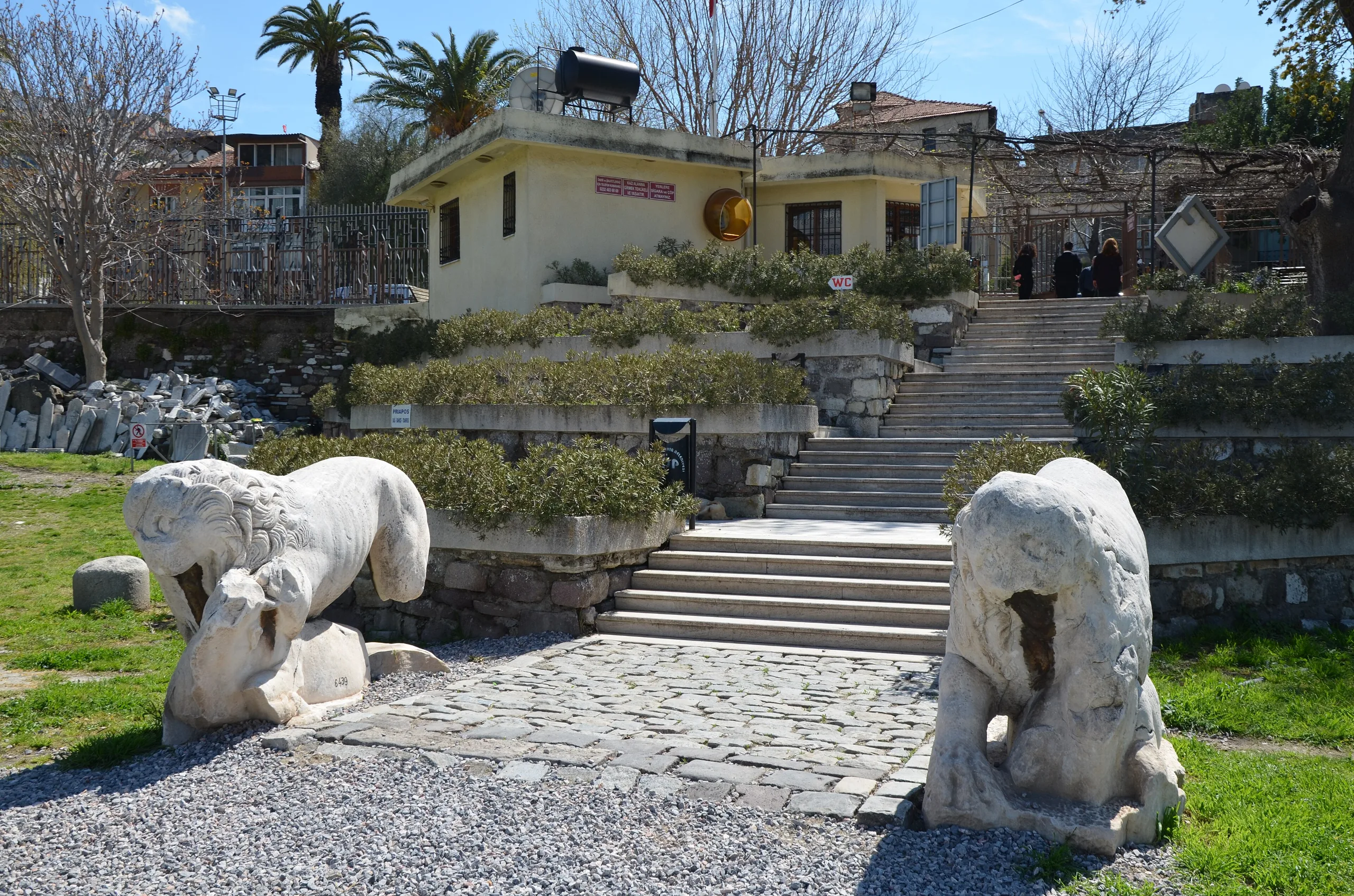
The site offers the Temple of Artemis, the bath-gymnasium, the synagogue and the Byzantine shops, while Bin Tepe is a separate area. For current hours and fees use the official museum page.
Gallery
Frequently asked questions
Where is Sardis?
Why is Sardis important?
When did Sardis become a World Heritage Site?
What is Bin Tepe?
When was the Sardis synagogue built?
Who excavated Sardis?
Sources (16)
- Sardes Örenyeri ve Bin Tepe Tümülüsleri / Sardis and the Lydian Tumuli of Bin Tepe (TR ve EN sayfaları) — T.C. Kültür ve Turizm Bakanlığı, Müzeler ve Ören Yerleri
- Sardis and the Lydian Tumuli of Bin Tepe — UNESCO World Heritage List 1731 — UNESCO World Heritage Centre
- ICOMOS Advisory Body Evaluation — Sardis (1731) — ICOMOS
- Nomination Text — Sardis and the Lydian Tumuli of Bin Tepe (1731) — T.C. Devlet Taraf (aday dosyası), UNESCO WHC
- About Sardis — The Archaeological Exploration of Sardis (Harvard Art Museums)
- Bin Tepe, The Tumulus of Alyattes, and Karnıyarık Tepe — The Archaeological Exploration of Sardis (Harvard Art Museums)
- Sardis (Pleiades place 550867) — Pleiades
Photo credits
- Photo: Egisto Sani from Viareggio, Italia, CC BY-SA 2.0 — Wikimedia Commons (resized)
- Photo: Carole Raddato from FRANKFURT, Germany, CC BY-SA 2.0 — Wikimedia Commons (resized)
- Photo: Egisto Sani from Viareggio, Italia, CC BY-SA 2.0 — Wikimedia Commons (resized)
- Photo: Egisto Sani from Viareggio, Italia, CC BY-SA 2.0 — Wikimedia Commons (resized)
- Photo: Egisto Sani from Viareggio, Italia, CC BY-SA 2.0 — Wikimedia Commons (resized)
- Photo: Egisto Sani from Viareggio, Italia, CC BY-SA 2.0 — Wikimedia Commons (resized)
- Photo: Egisto Sani from Viareggio, Italia, CC BY-SA 2.0 — Wikimedia Commons (resized)
- Photo: Egisto Sani from Viareggio, Italia, CC BY-SA 2.0 — Wikimedia Commons (resized)
- Photo: Egisto Sani from Viareggio, Italia, CC BY-SA 2.0 — Wikimedia Commons (resized)