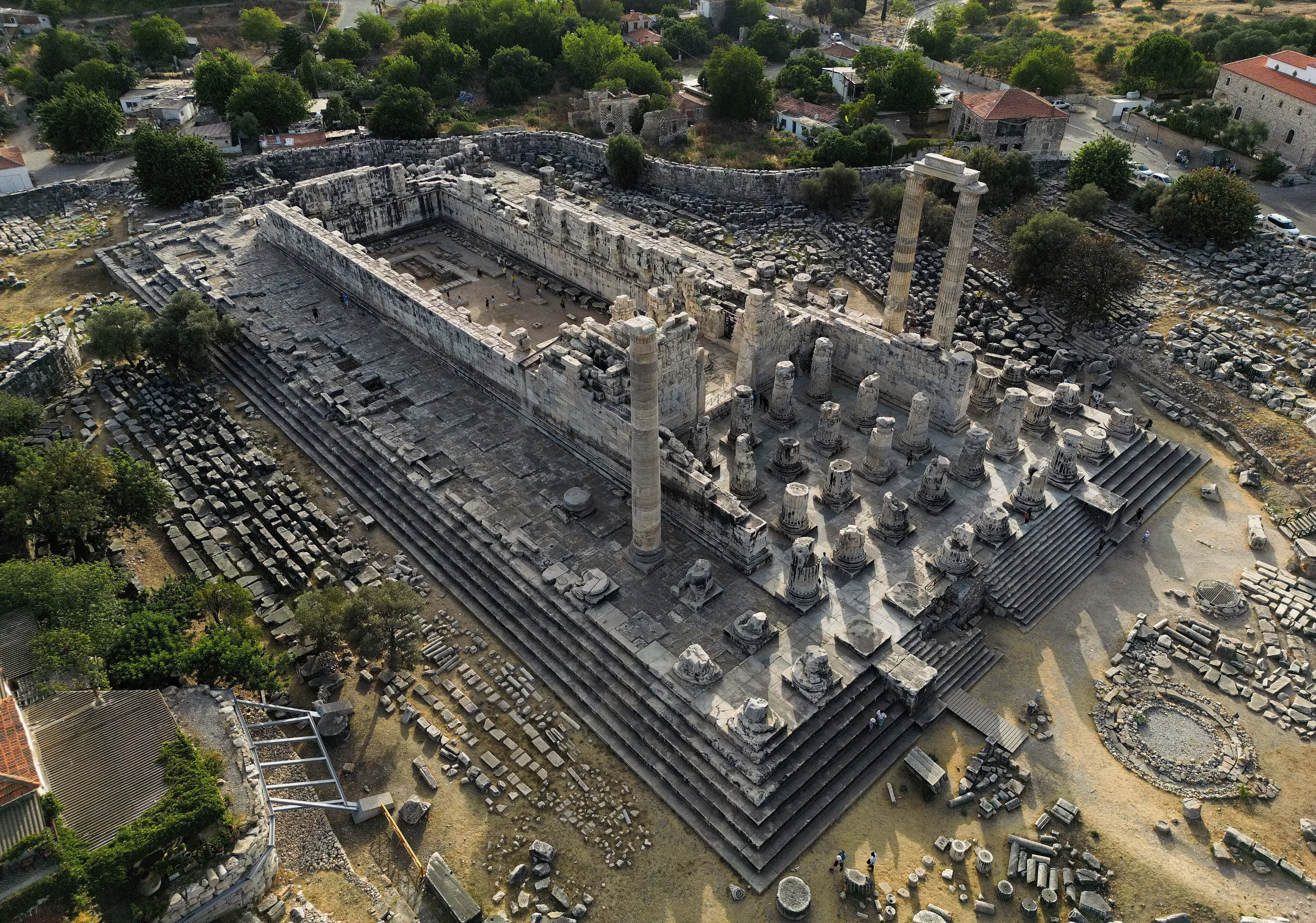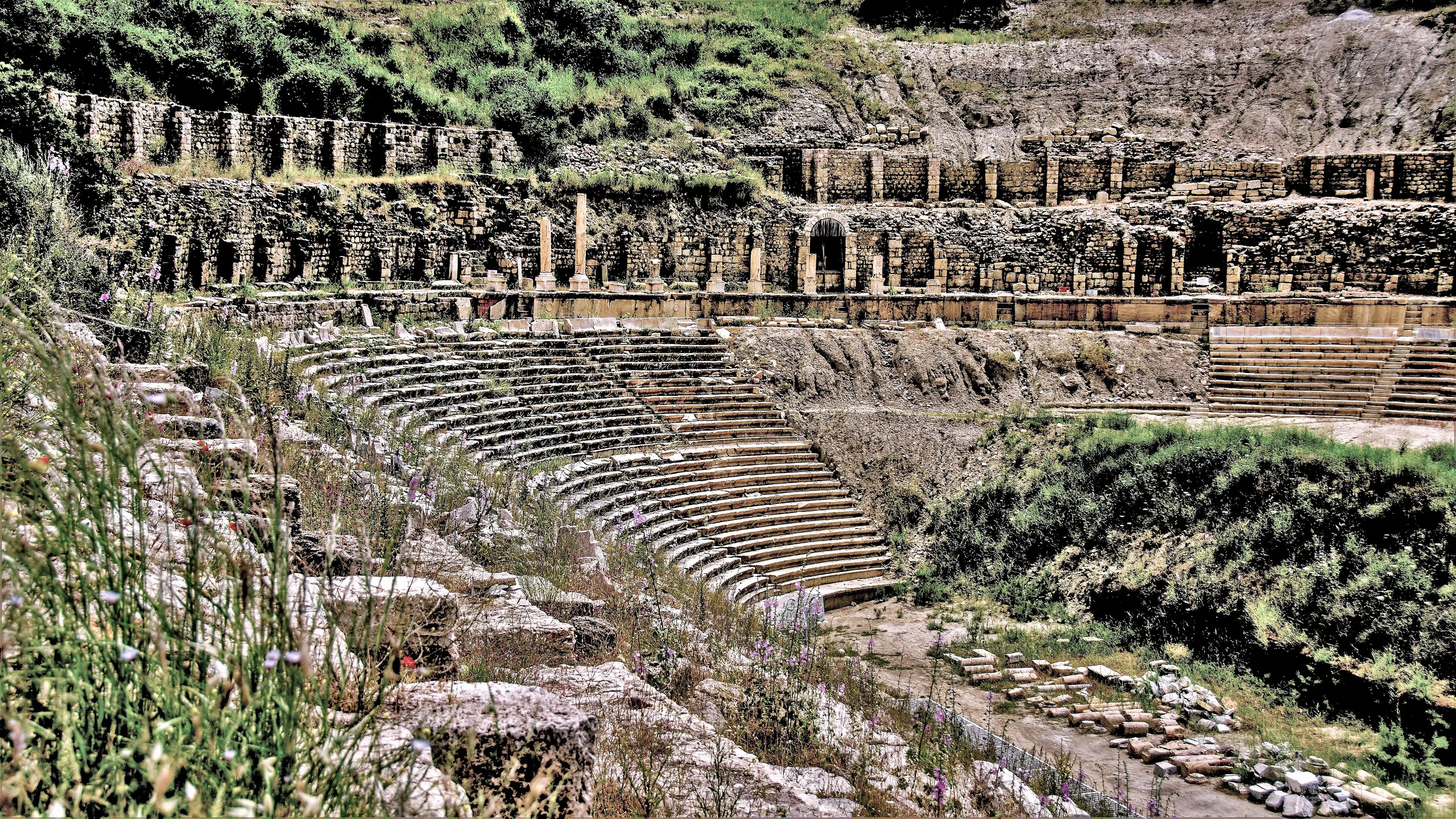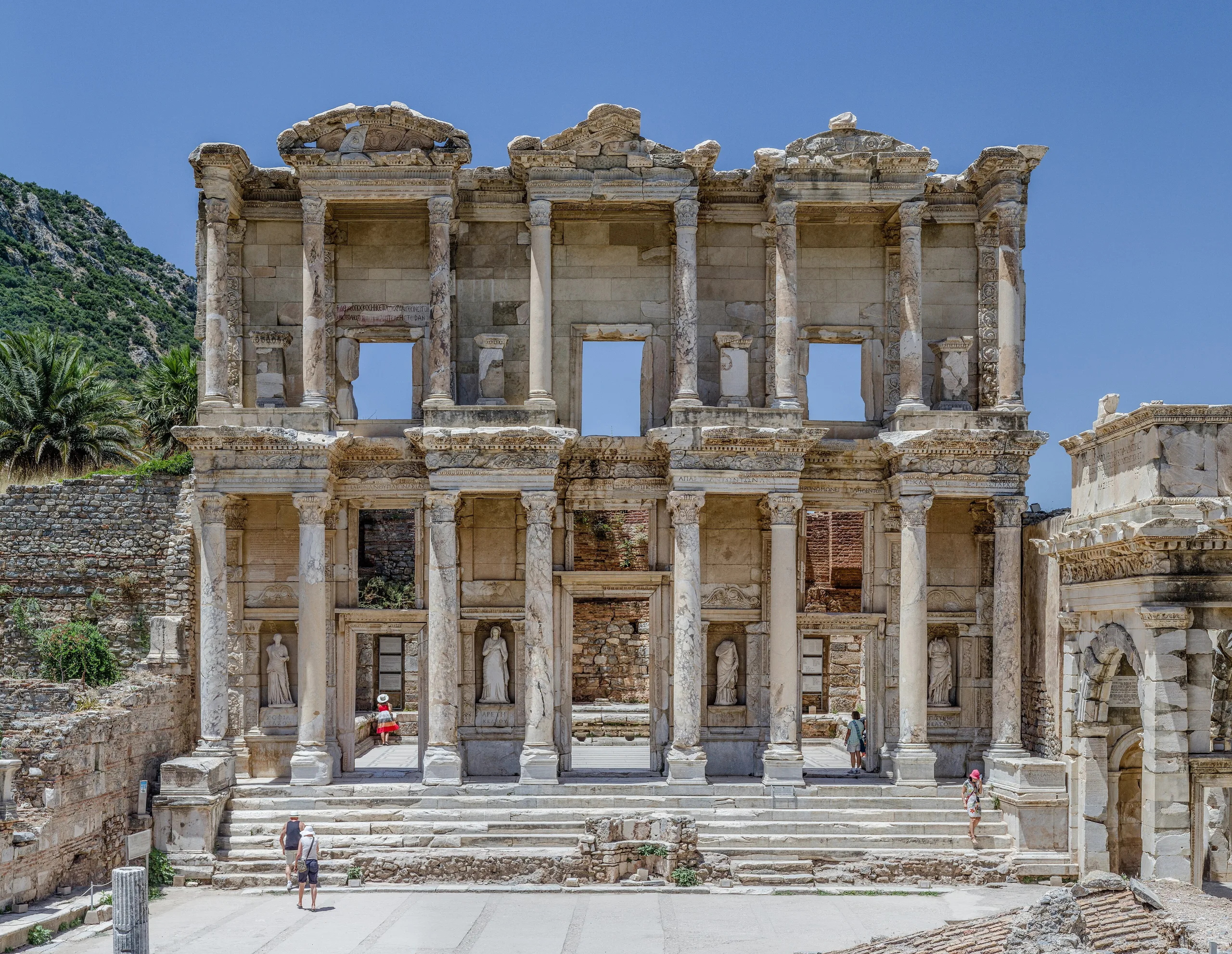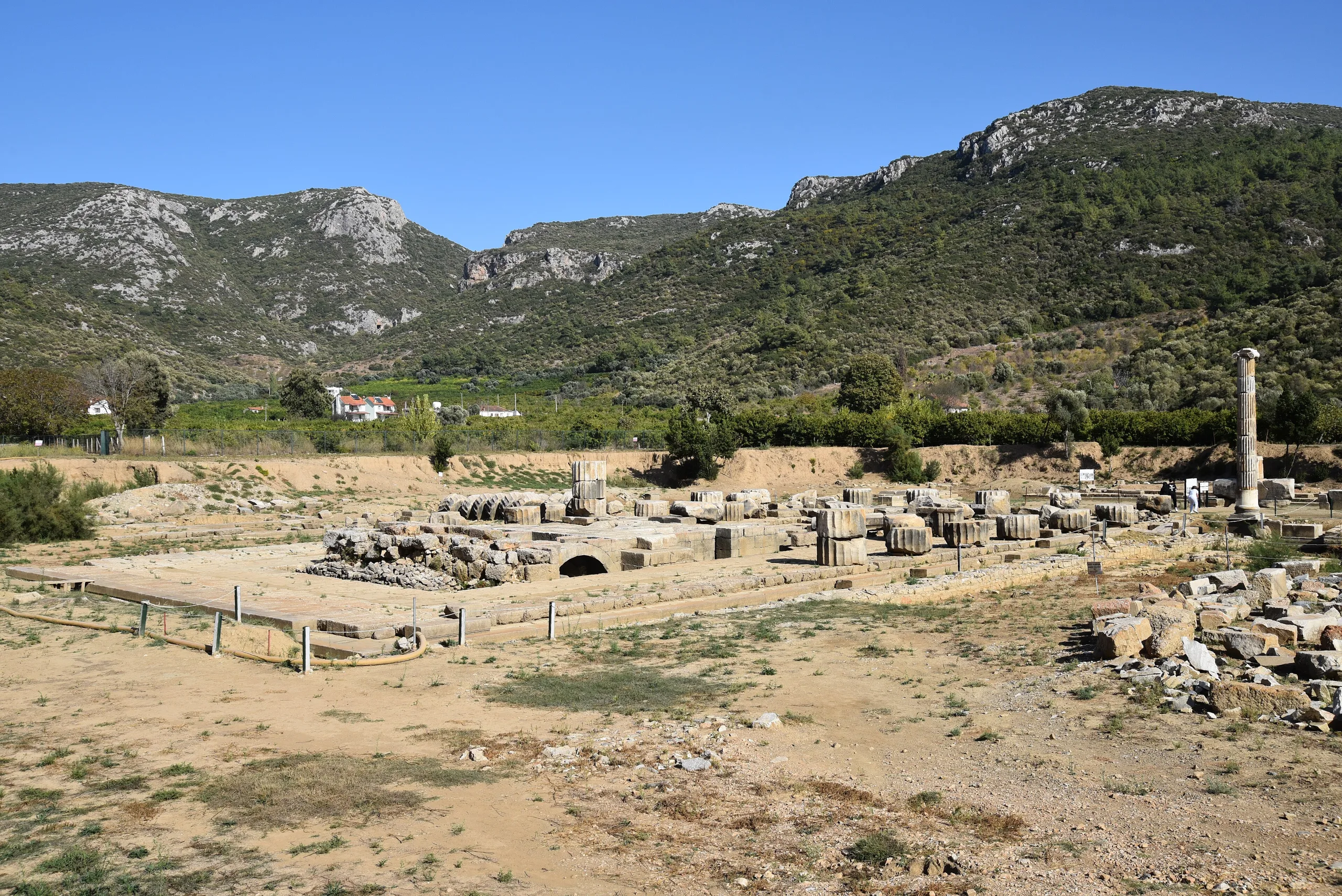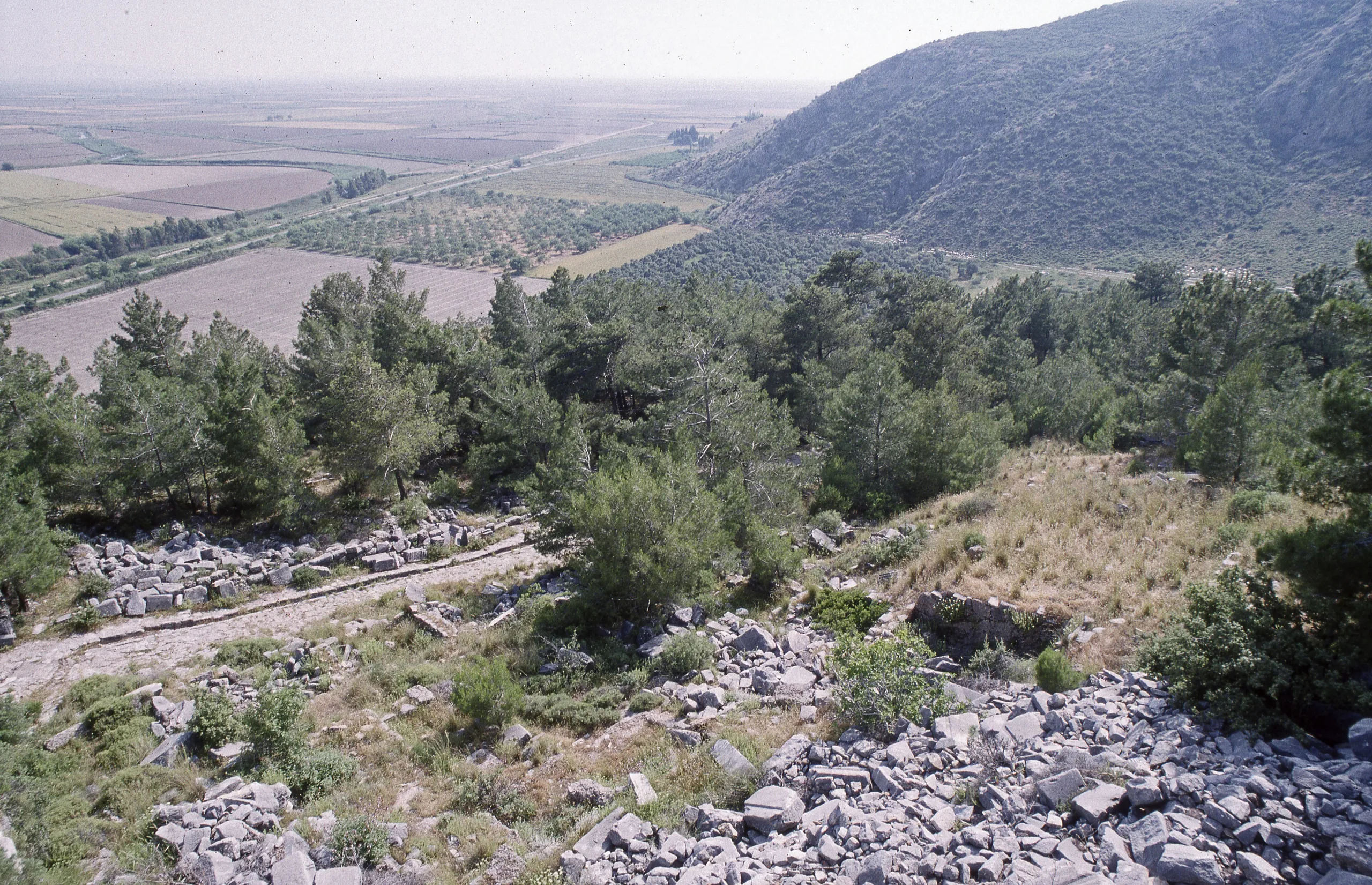
Priene, called the Pompeii of Asia Minor, climbs the slope of Mycale with a gridded street plan, an Athena temple, a theatre and houses that preserve Hellenistic town life.
Priene is an ancient city located in Turkey, Aydin. Main periods: Classical Period, Hellenistic Period, Roman Period, Byzantine Period.
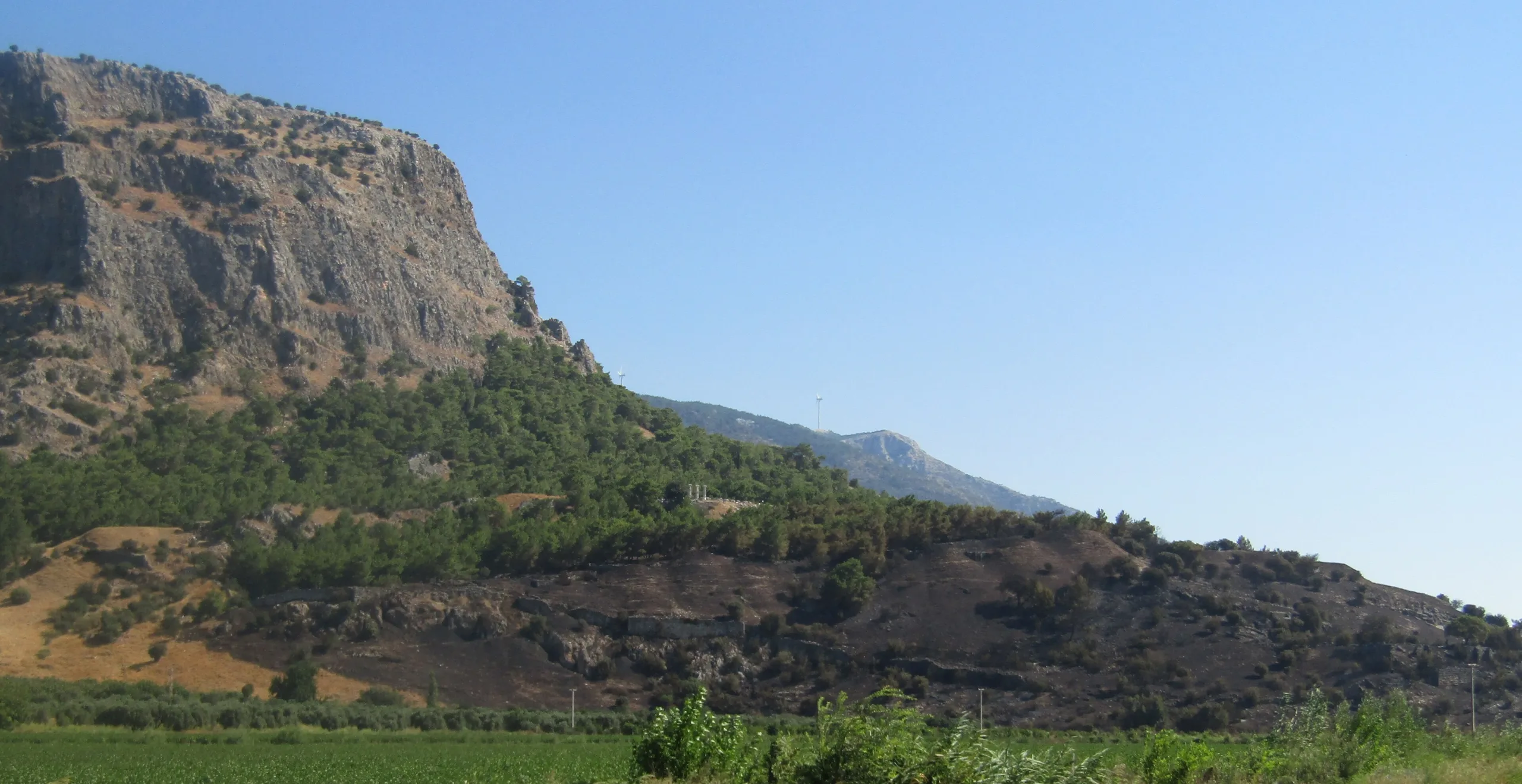
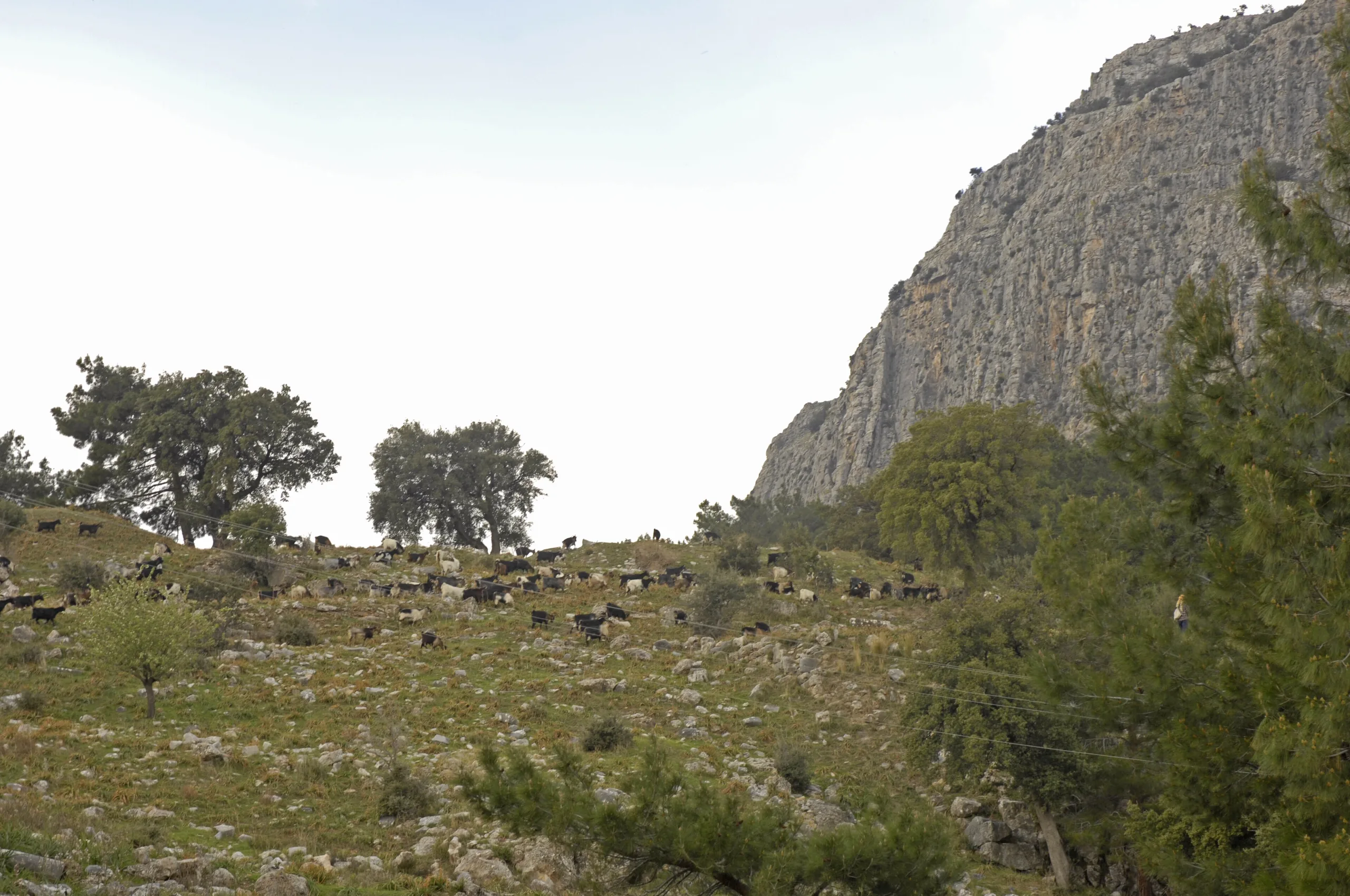
Theodor Wiegand nicknamed Priene the Pompeii of Asia Minor, and the label fits: nobody resettled the place after Byzantine times, so its streets, houses and public buildings carry Hellenistic daily life down to us in unusually good shape. The Ionian city lies in Güllübahçe village, Söke district, Aydın Province, on the southern slope of Mycale (Mount Samsun), about 15 km south-west of Söke. It stands roughly 500 m north of the Maeander river and 15 km inland from the Aegean, and is presented as the finest example of ancient town planning.
Location and access
The site is close to the settlement of Güllübahçe. Because it sits on a wooded, park-like plateau, it is explored on foot. See the official page for hours and fees. The Müzekart pass is valid for Turkish citizens.
History
Priene is one of the twelve Ionian cities named by ancient writers. Its founding is placed at the end of the 10th century BC or, at the latest, in the 8th century BC; knowledge of the original foundation still rests on assumption, and its past may reach back to the 2nd millennium BC. In about 125 years of systematic excavation, nothing older than the Late Classical period has come to light, so the Archaic and Classical town is believed to have stood somewhere else.
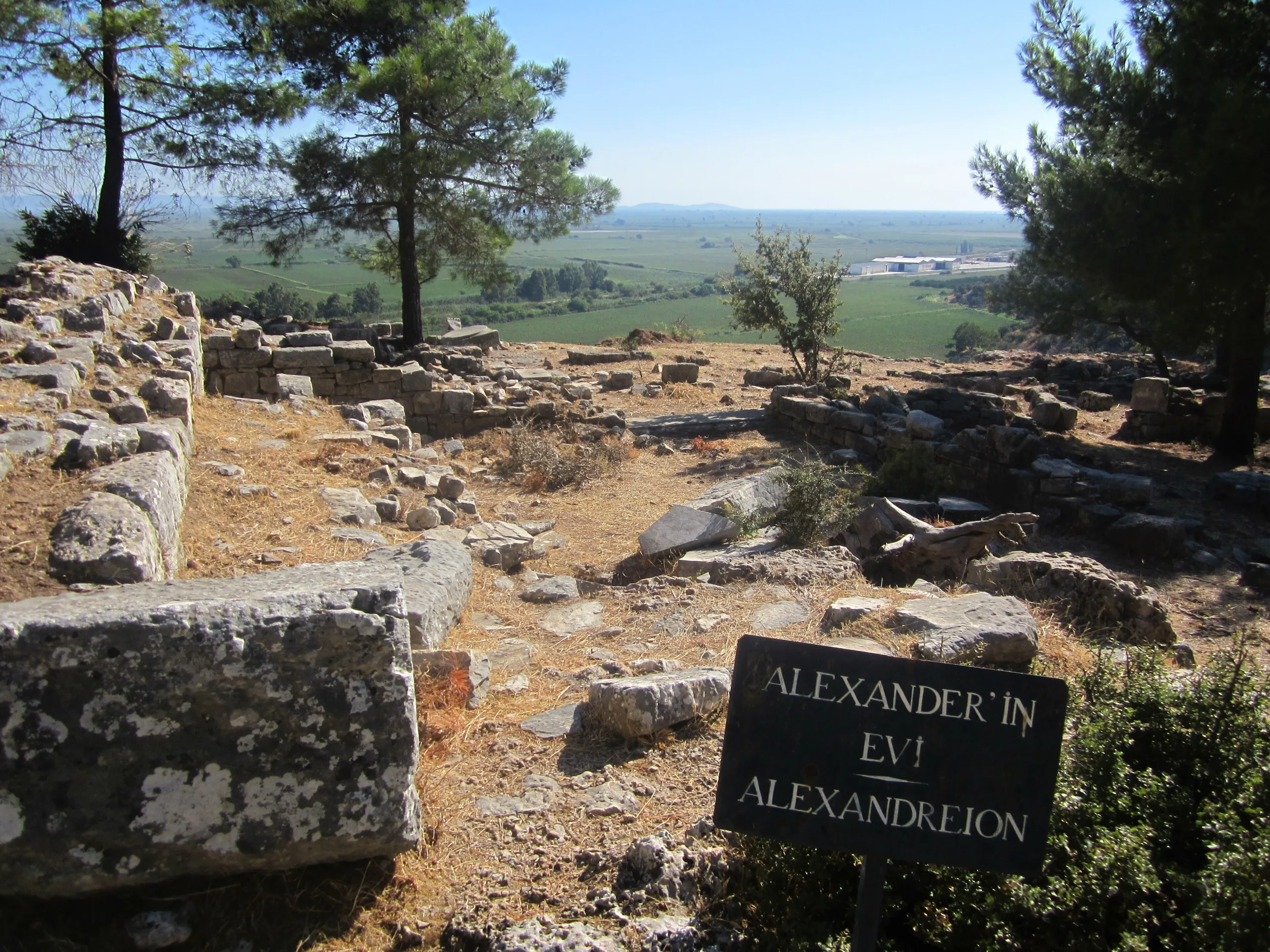
That older Priene was abandoned around 350 BC when the Maeander silted up the gulf, and the city was refounded where its ruins lie today, below the rock of Teloneia. Pausanias reports that it was first a Carian town, then taken by Ionians and Thebans. In the 6th century BC Bias, one of the Seven Sages, lived here; the city passed under Lydian rule and from 546 BC under Persian rule. It joined the Ionian Revolt of 499/494 BC and for a time in the 5th century belonged to the Delian League. Alexander the Great granted it autonomy, after which it lay under the Ptolemies, the Seleucids and the kingdom of Pergamon before passing to Rome around 133 BC.
Under Rome, Priene did not share in the general recovery that its neighbour Miletus enjoyed. Bishops are attested from the 5th century AD to 1270, and the city, by then called Samson, was left empty once the Turks took it. The fact that no one resettled it after the Byzantine era is the main reason it survives so well.
Notable structures
Town plan and houses
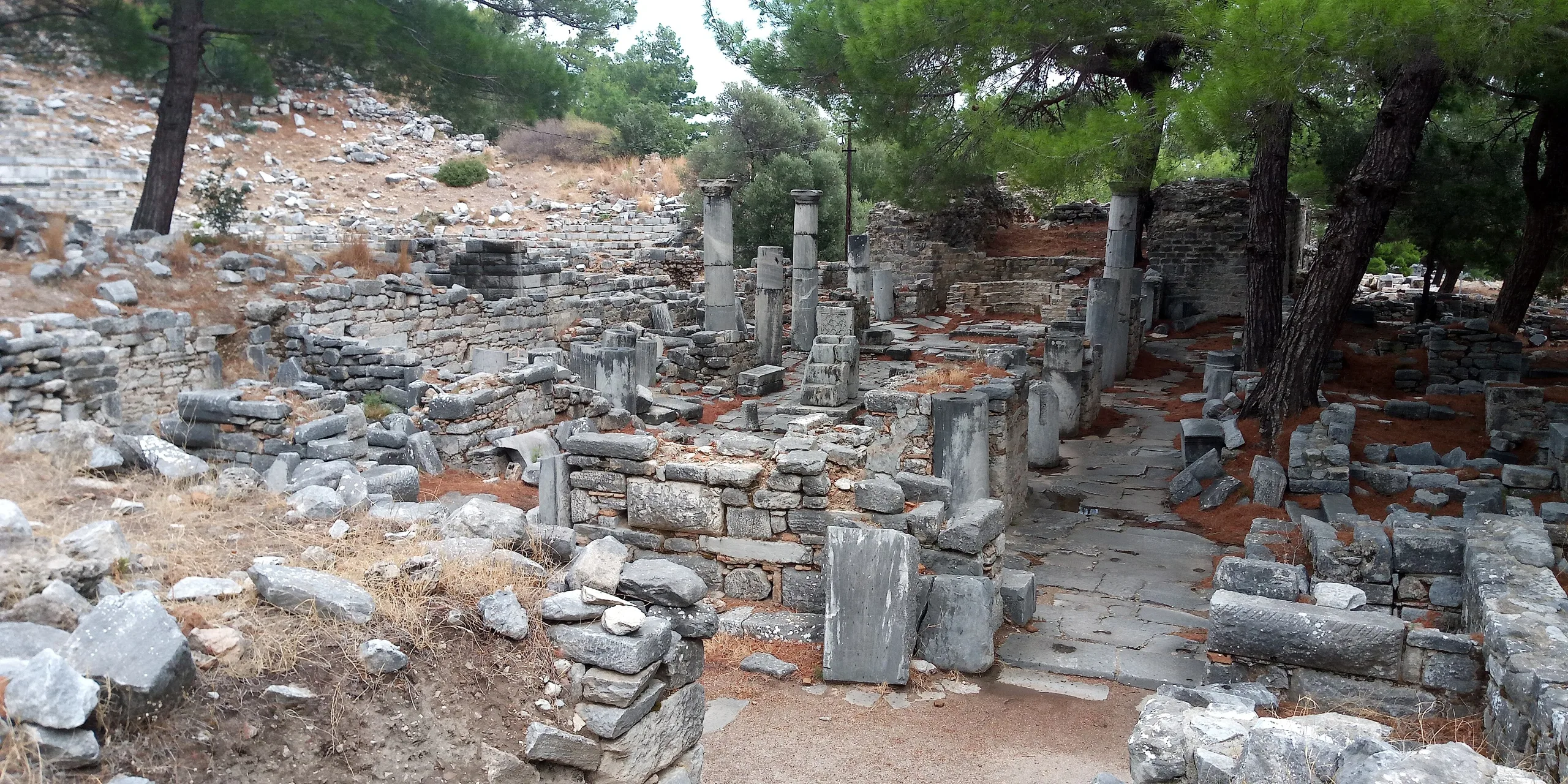
The city follows the grid system developed by Hippodamus of Miletus: the 4th-century plan is rectangular, streets run along the compass points, and each insula, or housing block, may originally have been split into eight long plots. Side streets are generally 3.5 m wide and stepped because of the slope, and public buildings often fill an entire block in the centre. Three gates open in the walls, one in the west and two in the east.
Houses typically had four main rooms facing north: a prostas (entrance porch), an andron (men's dining room), an oikos (main living room) and a side room beside it. They rank among the best examples of Late Classical and Hellenistic domestic architecture and changed very little under Rome.
Sanctuary of Athena
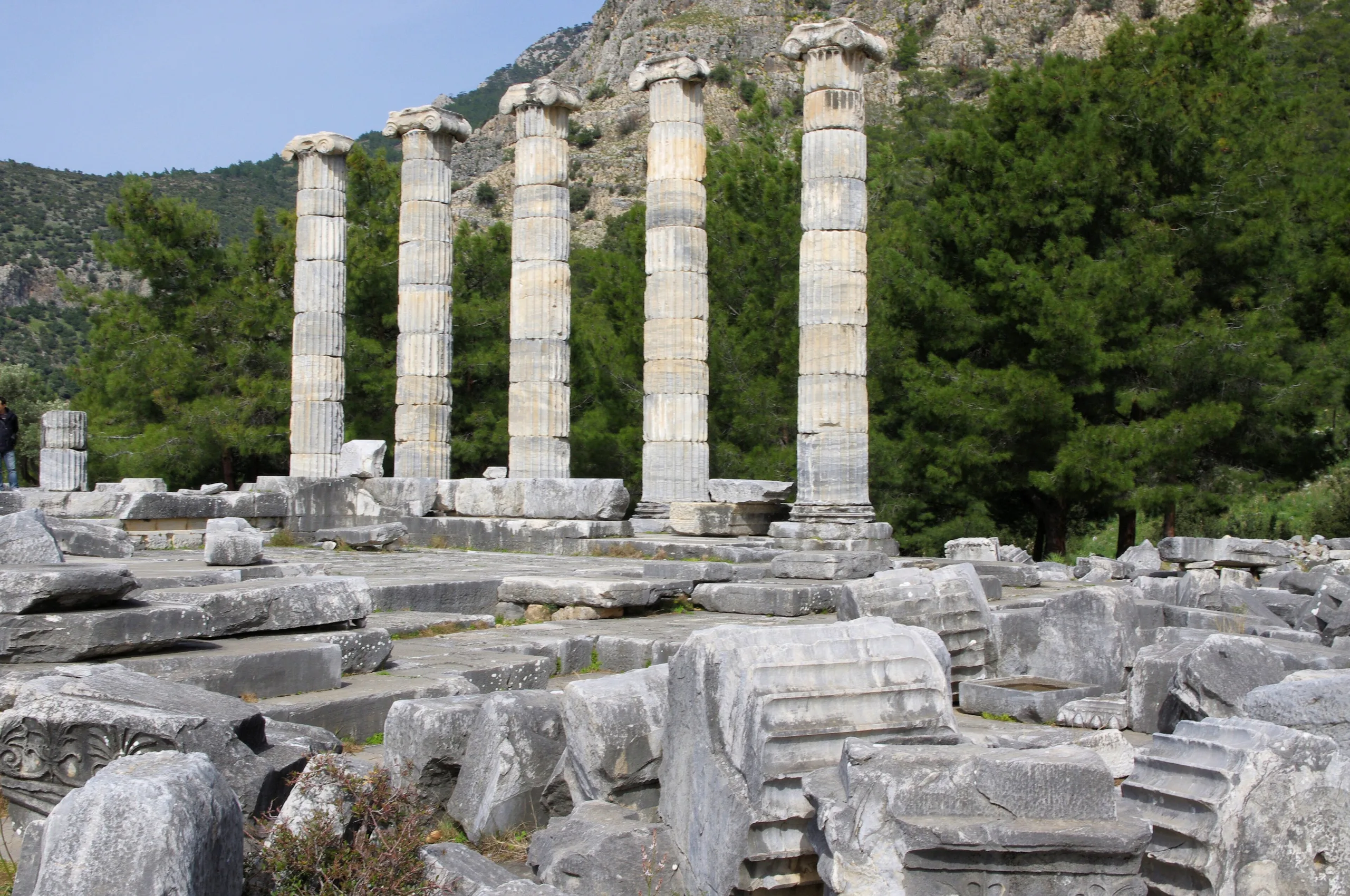
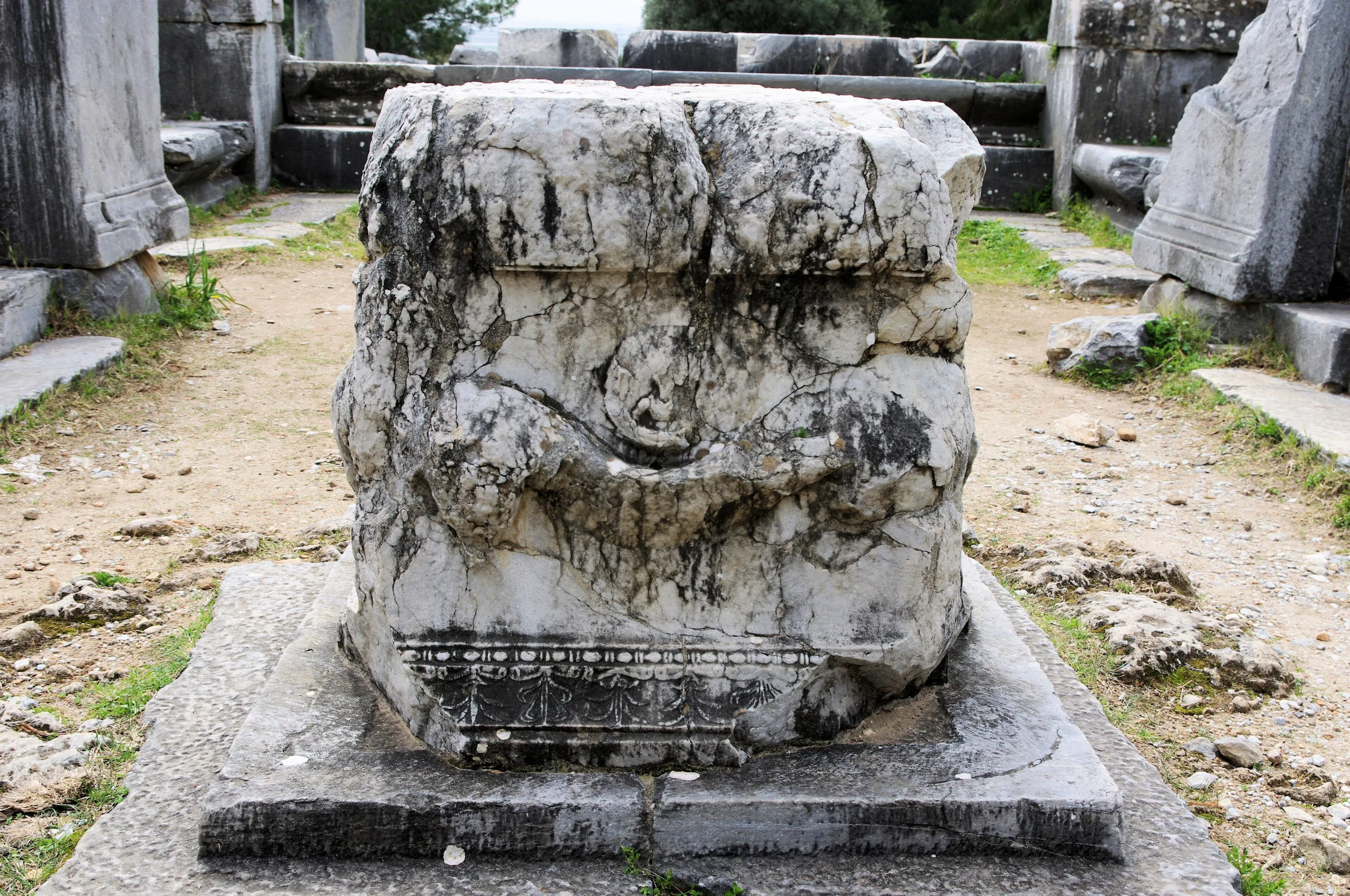
The Temple of Athena, on one of the highest parts of the city, dates to the 4th century BC. Visitors come into the sanctuary through a monumental propylon, or gateway, and find an altar; the temple is set apart from the altar by an architrave carrying a Greek inscription. Its architect was Pytheos, a master of the Ionic order. The naos, the temple's inner chamber, and the cult statue were finished before 323 BC, while the surrounding colonnade took centuries to complete. A dedicatory inscription of Alexander the Great was found here. By basing every element of the plan on one module, Pytheos opened a new era in temple design. Under Augustus the sanctuary gained a monumental propylon and the temple was dedicated to him as well.
Theatre
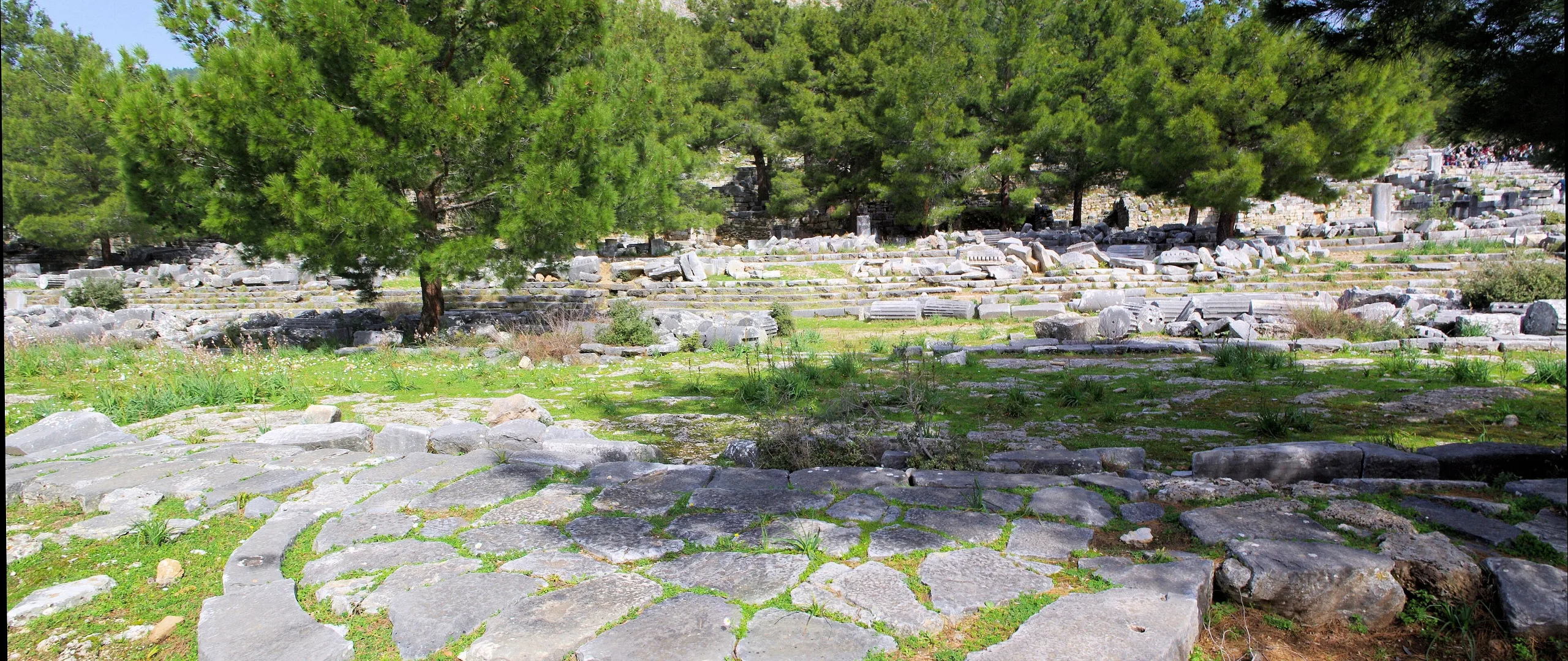
The theatre is the only one in western Anatolia that the Romans did not substantially enlarge, and it serves as the standard Hellenistic model. Games for Dionysus were first held down in the orchestra and later moved onto a wooden-floored proskenion, the stage platform. Beside the orchestra, Dionysus's altar survives.
Agora, bouleuterion and prytaneion
The agora was being extended by the 3rd century BC at the latest and was framed with stoas. The bouleuterion, or council house, was built somewhere between 200 and 150 BC and is regarded as the best-preserved building of its type. The prytaneion was the working seat of the city's executive committee; it received foreign envoys, and the sacred fire of Hestia burned there without a break. The building could hold at least 500 councillors.
Gymnasia and walls
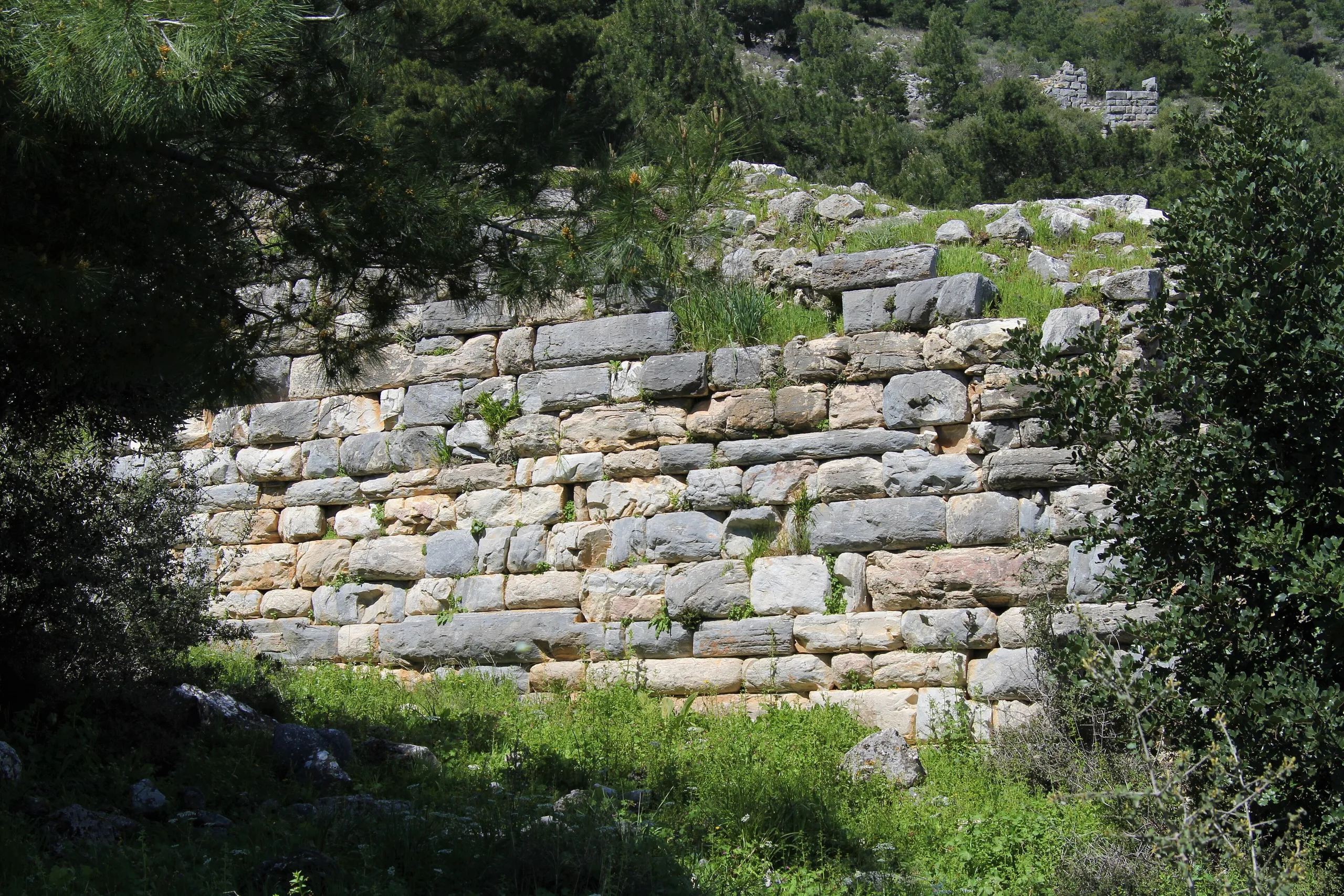
The lower gymnasium comprises a peristyle building, an ephebeum (the young men's training hall), washrooms and a stadium; many names scratched by students show on the ephebeum walls. The city wall and the water system count as good evidence of ancient technology. The East Gate was once Priene's grandest gateway and began the road to Magnesia.
Basilica
The bishop's church, the Basilica, was built in the 5th-6th centuries AD from reused material, including pieces of the Athena Temple's south gallery. An early Jewish synagogue and Christian chapels dating from the 5th century also stand in the city.
Excavations
English merchants found the site in 1673 while hunting for the Athena Temple, and short campaigns followed in the 18th and 19th centuries. The first scientific German excavation began under Carl Humann in 1894 with Ottoman permission. After his death, Theodor Wiegand and Hans Schrader worked here from 1895 to 1899 and uncovered most of the city. Armin von Gerkan studied the theatre in 1911-1912.
After a long pause, research resumed in 1977 under Wolfgang Müller-Wiener and lasted until 1982. From 1990 to 2013 a team from the German Archaeological Institute and Goethe University Frankfurt worked under Wolf Koenigs and then Wulf Raeck. Since 2014 a Turkish-German team led by Hasibe Akat İslam of the Miletus Museum has carried on, with İbrahim Hakan Mert of Uludağ University as scientific adviser. None of the teams has practised anastylosis (re-erecting fallen buildings from their original pieces) or reconstruction, choosing to leave the ruins in their natural state.
Myth and ancient authors
Vitruvius wrote about the Athena temple, and that literary fame is why people went looking for it from the 17th century on. Priene was home to Bias of the Seven Sages and managed the Ionian League's shrine, the Panionion. Pausanias says it was taken from the Carians. The temple's architect, Pytheos, is also credited with the Mausoleum at Halicarnassus.
UNESCO and protection
Priene was placed on UNESCO's Tentative List on 2 May 2018 under criteria (ii), (iii), (iv) and (vi) (ref. 6348); it is not yet a World Heritage property. The İzmir regional conservation council No. 2 registered the area as a first-degree archaeological site by decision No. 2719 of 3 June 1992, and Law No. 2863 protects it.
Visiting
The ruins occupy a wooded plateau and are best covered on foot. Check the official Priene page for current hours and prices.
Gallery
Frequently asked questions
Where is Priene?
Why is Priene famous?
Why did Priene move to its present site?
Who has excavated Priene?
Is Priene a World Heritage Site?
Why is Priene called the Pompeii of Asia Minor?
Sources (13)
- Priene Örenyeri / Priene Archaeological Site (TR ve EN sayfaları) — T.C. Kültür ve Turizm Bakanlığı, Müzeler ve Ören Yerleri
- Archaeological Site of Priene — UNESCO World Heritage Tentative List 6348 — UNESCO World Heritage Centre (Türkiye Daimi Delegasyonu başvurusu)
- Kısa Tanıtım / Brief Introduction | Priene Antik Kenti Alan Başkanlığı — Söke Belediyesi, Priene Antik Kenti Alan Başkanlığı
- Priene/‘Lince’? (Pleiades place 599905) — Pleiades
Photo credits
- Photo: Dosseman, CC BY-SA 4.0 — Wikimedia Commons (resized)
- Photo: Ken and Nyetta, CC BY 2.0 — Wikimedia Commons (resized)
- Photo: Ken and Nyetta, CC BY 2.0 — Wikimedia Commons (resized)
- Photo: Tomisti, CC BY-SA 4.0 — Wikimedia Commons (resized)
- Photo: Ken and Nyetta, CC BY 2.0 — Wikimedia Commons (resized)
- Photo: Christopher de Lisle, CC BY-SA 4.0 — Wikimedia Commons (resized)
- Photo: O.Mustafin, CC0 — Wikimedia Commons (resized)
- Photo: Dosseman, CC BY-SA 4.0 — Wikimedia Commons (resized)
- Photo: Rabe!, CC BY-SA 4.0 — Wikimedia Commons (resized)